





Makalu Expedition ( 8485m )
Overview
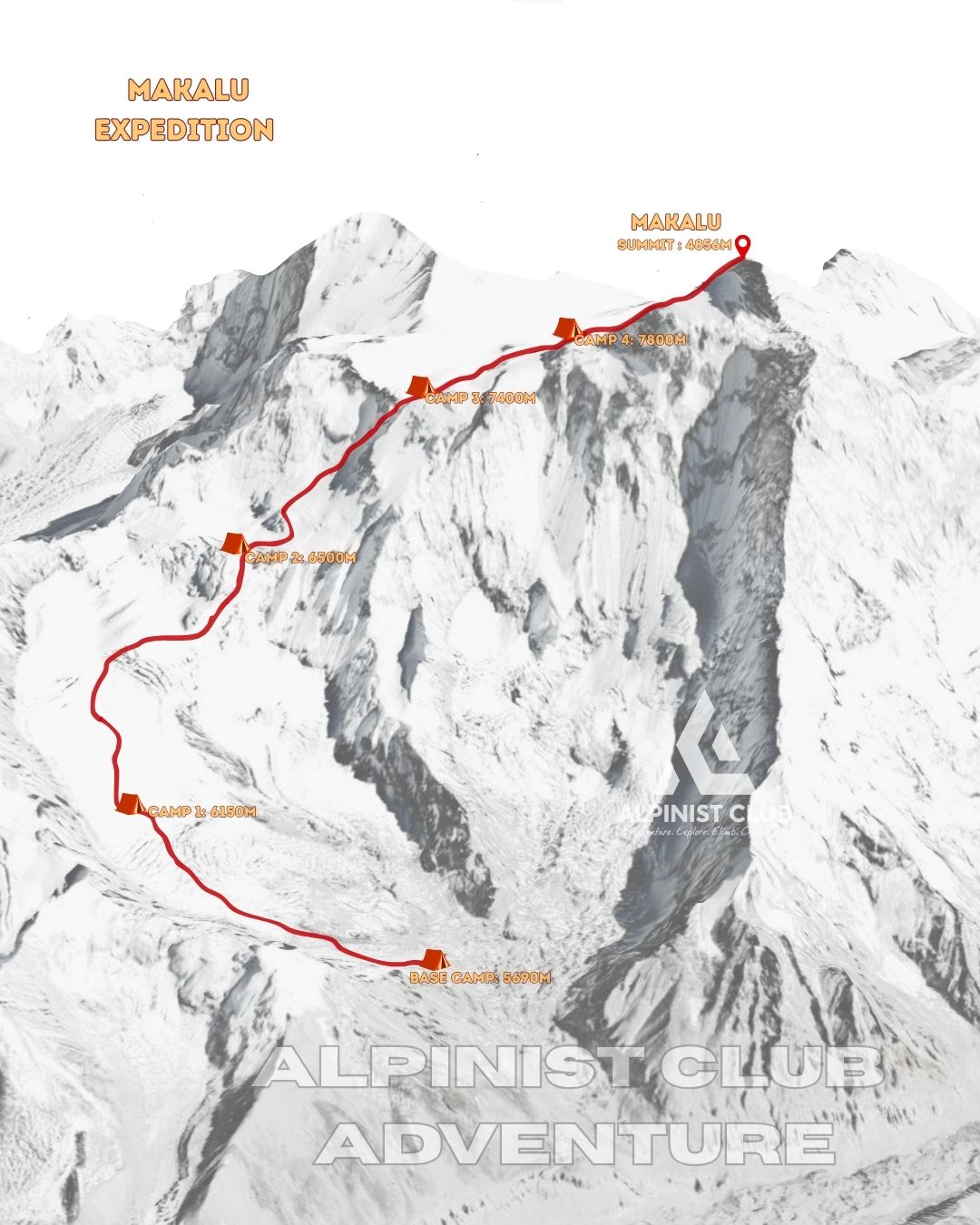
Makalu Expedition Route | magnificent pyramid
Makalu is one of the most beautiful mountains in the Himalaya. famously called it “a magnificent pyramid isolated in a wild region.” Its striking shape and isolation continue to inspire climbers from around the world.
The adventure begins with an 11-day approach trek along the historic Shipton’s Trail, allowing for gradual acclimatization while crossing pristine valleys, dense forests, and remote mountain landscapes. This lesser-traveled route highlights the true wilderness of eastern Nepal and sets the tone for the demanding ascent ahead.
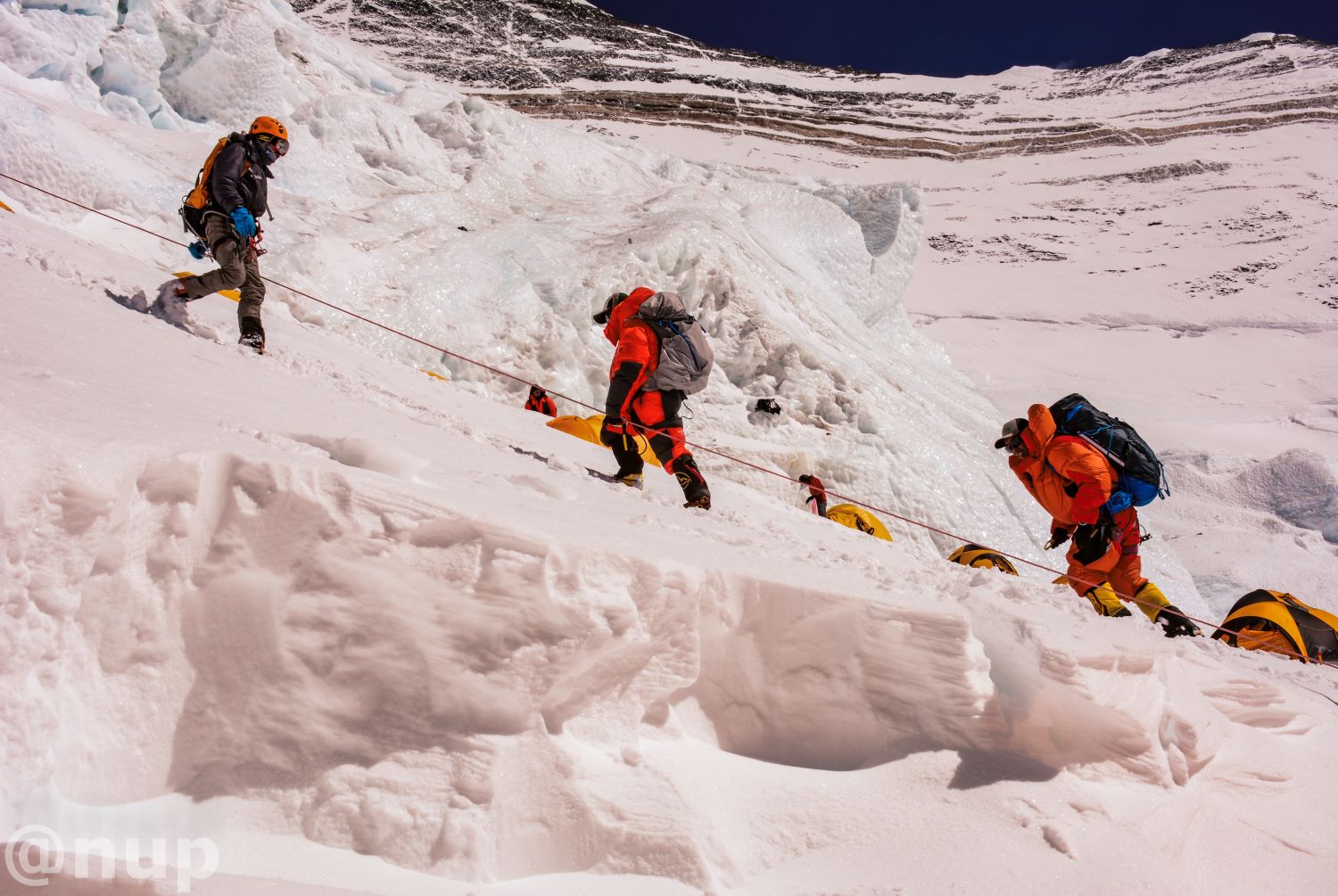
The climbing phase starts after Base Camp and is carried out using four high camps. The route is physically and technically demanding, requiring excellent endurance and solid mountaineering skills. The most difficult section lies between Camp 2 (6,600 m) and Camp 3 (7,500 m), where climbers must negotiate a long, exposed spur of mixed terrain consisting of snow, ice, and rock.
A key challenge of this section is the absence of any suitable location for an intermediate camp. Climbers must complete this long and sustained stretch in a single push, which demands excellent physical fitness, efficient movement, and strong mental focus. Proficiency in rope techniques, including rappelling, is essential for both ascent and descent.
The final climb to the summit is steep and exposed, leading to one of the most impressive summits in the Himalaya. Standing on the top of Makalu is a powerful achievement, offering spectacular views and a deep sense of accomplishment earned through commitment and skill.
The Makalu Expedition is ideal for mountaineers seeking a serious, technical, and less-crowded 8,000-meter peak. It is a true test of high-altitude ability and a memorable journey into one of Nepal’s wildest mountain regions.
Itinerary
Expand All- Mode of transfer/transport: private minibus
- Meals: Dinner
- Accommodation: Night at the hotel
- Meals: Breakfasts at the hotel
- Accommodation: Nights at the hotel
- Duration of transfer/transport: Approximately 3 hours
- Flight duration: Approximately 1 hour
- Final altitude: Approximately 1,490 m
- Meals: breakfast at the hotel – lunch – dinner
- Accommodation: Night in the lodge
- Approximately 5 hours of Trek
- Elevation gain/loss: + 950 m / - 235 m
- Final altitude: Approximately 1,600 m
- Meals: Breakfast – lunch – dinner
- Accommodation: Night in a lodge
- 6 hours of Trek
- Elevation gain/loss: + 750 m / - 180 m
- Final altitude: Approximately 2,135 m
- Meals: Breakfast – lunch – dinner
- Accommodation: Night in the lodge
- 6 hours of trek
- Elevation gain: + 1,100 m
- Final altitude: approximately 3,470 m
- Meals: Breakfast – Picnic– dinner
- Accommodation: Night in a lodge
- 6 hours of trek
- Elevation gain/loss: + 950 m / - 630 m
- Final altitude: Approximately 3,800 m
- Maximum altitude: Approximately 4,217 m
- Meals: Breakfast – lunch – dinner
- 5 hours of Trek
- Elevationgain/loss: + 400 m / - 600 m
- Final altitude: Approximately 3,650 m
- Meals: Breakfast – Lunch – Dinner
- Final altitude: Approximately 3,650 m
- Meals: breakfast – lunch – dinner
- Accommodation: Night in the lodge
- Number of hours of walking: approximately 5 hours of trek
- Elevation gain/loss: + 800 m / - 35 m
- Final altitude: Approximately 4,300 m
- Meals: Breakfast – lunch – dinner
- Accommodation: Night in the lodge
- 4 hours Trek
- Elevation gain/loss: + 520 m / - 100 m
- Final altitude: approximately 4,870 m
- Meals: Breakfast – lunch – dinner
- Accommodation: Night in lodge
- Final Altitude: Approximately 4,870 m
- Maximum Altitude: Approximately 5,795 m
- Meals: breakfasts – lunches – dinners
- Accommodation: Nights in a lodge
- 7 hours of Trek
- Elevation gain: + 820 m
- Final altitude: Approximately 5,690 m
- Meals: Breakfast – lunch – dinner
- Accommodation: Night in the tent
- Advanced base camp (5,690 m) to Camp 1 (6,165 m): 6 hours
- Camp 1 (6,165 m) to Camp 2 (6,600 m): 3 to 4 hours
- Camp 2 (6,600 m) to Camp 3 (7,500 m): 8 to 9 hours
- Camp 3 (7,500 m) to Camp 4 (7,750 m): 4 to 5 hours
- Approximately 6 hours
- Final altitude: Approximately 4,100 m
- Meals: Breakfast in the lodge – lunch – dinner in the lodge
- Accommodation: Night in the lodge
- Number of hours of walking: Approximately 6 hours
- Final altitude: Approximately 3,800 m
- Meals: Breakfast – lunch – dinner
- Accommodation: Night in the lodge
- 6 hours of trek
- Final altitude: Approximately 2,135 m
- Meals: Breakfast – lunch – dinner
- Accommodation: Night in the lodge
- 6 hours Trek
- Final altitude: Approximately 1,490 m
- Meals: Breakfast – lunch – dinner
- Accommodation: Night in the lodge
- Duration of transfer/transport: Approximately 4 hours
- Meals: Breakfast – lunch – dinner
- Accommodation: Night at the hotel
- Mode of transfer/transport: Plane
- Flight duration: approximately 1 hour
- Meals: breakfast
- Accommodation: night at the hotel
- Mode of transfer/transport: Plane
- Flight duration: Approximately 1 hour
- Meals: Breakfast
- Accommodation: Night at the hotel
- Meals: Breakfast at the hotel
- Accommodation: Night at the hotel
Free time depending on the
departure time of your flight and our representative will drop you at the
airport, ending your journey in Nepal. We hope to be of service to you again.
Thank you and safe travels
Note:
If you have a private group and prefer a personalized experience, we can organize a custom trip tailored to your requirements and group size, running it any day you choose.
Plan a Private TripIncluded & Excluded
Included Points
Excluded Points
Trip Information
Your Guide and Team
Your guide, from your arrival in Kathmandu until your departure, is responsible for the success of your trip and oversees your team. Do not hesitate to ask him questions, respect his position as the team leader, and above all follow his advice! Often your guide is the only English-speaking member of the team. In the mountains and, especially when during high-altitude travels, your guide is responsible for the safety of the group. The instructions he gives and the remarks he makes to all participants must be carefully followed. The interest and safety of the trekking group must be preserved, even when it may be to the detriment of an individual member of the group.
Read MoreYour Nepalese team may consist of several people, each with different responsibilities. They are:
- The Guide Leader (Sirdar) is responsible for and leader of the whole team and is treated with respect by all. Often he has earned his position by starting as a porter and rising through the ranks.
- climbing sherpa: Experience mountain Guide, fixed rope, and guided to the summit
- The Cook is responsible for all meals and is on a trek that doesn’t use lodges for meals.
- The kitchen boy is an assistant to the cook. )
- The Assistant Guide is actively helping clients under the leader’s direction and set camp.
- The Porter is the load carrier for the trekking group. As Nepal is a mountain country with few roads, porters are employed to carry loads. Compliance with regulations and common courtesy dictates the maximum weight carried and the minimum wage paid. Porters are provided with gear based on the routes they follow and with insurance for alpine treks.
Accommodations in Kathmandu
- Hotel Himalayan suit: Located in the heart of Thamel, this hotel is ideal for walking the bustling streets of Kathmandu. The spacious rooms all have a bathroom, air conditioning, and Wi-Fi. A fully equipped and active dining room is available for all meals, and the breakfast buffet offers a wide choice of foods. The hotel offers currency exchange, laundry services, and luggage storage.
- Sampada Garden: Located just 20 minutes on foot from Thamel and Durbar Square, this hotel is convenient for exploring Kathmandu. The rooms have all the necessary comforts for your stay: air conditioning, bathroom, and Wi-Fi. Breakfasts are served as a generous buffet. The hotel provides currency exchange, laundry services, and luggage storage.
Accommodations during the Expedition
- Breakfast: eggs, toast or chapati, or Tibetan bread or pancakes, or pancakes, butter/jam, tea or coffee
- Lunch: a main course, tea or coffee
- dinner: soup, main course, fruit (fresh or canned), tea or coffee
- During the trek, tea or coffee is served with meals. Two cups per person are included.
- Apart from these included menus, other drinks and foodstuffs will be at your expense.
- Water: provide tablets (Hydroclovazone, Micropur, or another type) to disinfect the water you put in your water bottle, depending on the source and the advice of your guide. It is sometimes possible to buy purified water and refill your water bottle without having to buy bottled water. You can also buy mineral water in the cities (not included in the price) but its ecological balance is poor, as you know. Also, we do not recommend it.
Preparation for the Expedition
Medical check-up
Acute Mountain Sickness
Gears List
Trip Map
FAQ's
Expand AllOn May 15, 1955, Lionel Terray
and Jean Couzy, who were part of a French expedition headed by Jean Franco,
made the first ascent of Makalu, the fifth-highest mountain in the world.
Makalu has the fifth-highest
rating in the world and the fourth-highest rating in Nepal.
The elevation of Makalu is 8485
meters above sea level.
The needed permits to climb the
Makalu expedition are given below:
1. Makalu-Barun National Park
Entry Permit
2. Makalu Restricted Area Permit
3. Climbing Permit
The best seasons for the Makalu Expedition are
Spring and Autumn.
Mount Makalu is located in the
eastern region of Nepal, close to the Tibet (China) border, in the Mahalangur
Himalayas.
Several variables, including the
route chosen, the weather, and each climber's speed, affect how long the Makalu
Expedition lasts. It usually takes 45 to 60 days to complete the entire
excursion.
It wouldn't be an exaggeration to
say that ascending Makalu is more challenging than Everest. The first summit
did not make the Makalu trek any less dangerous. Mountaineers made several
attempts to reach Makalu, but they were unsuccessful due to the difficult path
and navigation.
The Makalu Expedition requires outstanding
strength, stamina, mental toughness, and physical condition. In addition to
specialized training and planning for high-altitude trips, prior mountaineering
expertise is required.