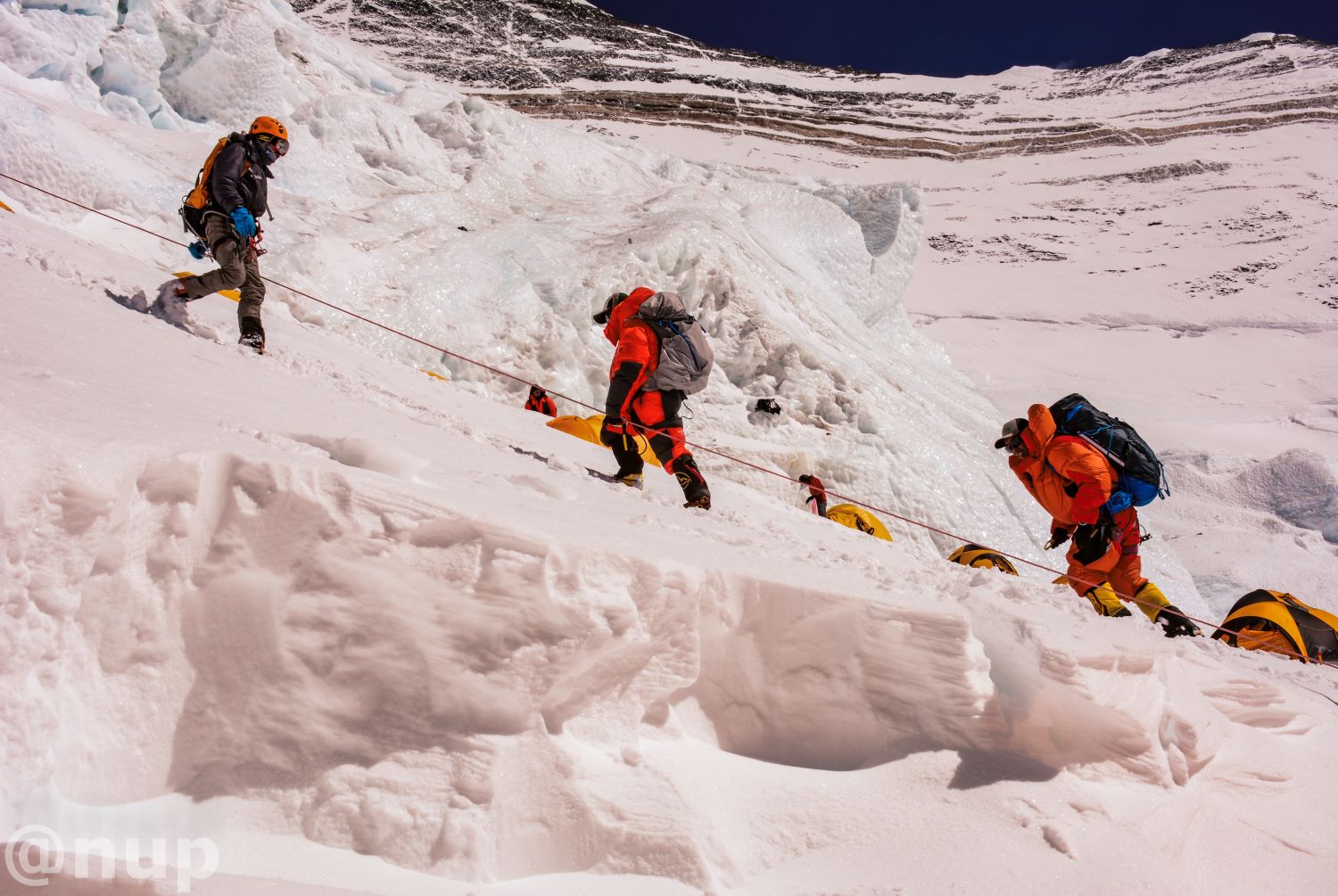
Kanchenjunga Expedition (8586m)

Dive into the heart of the Himalayas and discover Kangchenjunga—where rugged terrain and rich culture intertwine for an unforgettable expedition.

Kangchenjunga Expedition in Nepal (8,586 m) – World’s Third-Highest Peak

Kangchenjunga (8,586 m), the world’s third-highest mountain, is one of the most serious and demanding peaks in the Himalaya. Located in far eastern Nepal, this majestic and remote mountain is suitable only for highly experienced mountaineers with strong high-altitude and technical climbing skills.

The expedition challenges physical limits and mental resilience in extreme altitude and harsh conditions.
The climb features steep ice walls and crevasses, with unpredictable weather adding to the difficulty.
Climbers navigate untouched landscapes, encountering diverse wildlife and local cultures.
Third Highest Peak At 8,586 meters Kanchenjunga offers breathtaking views of the Himalayas,

Everest Very High altitude Kangchenjunga Very High altitude

Safety has always been our top priority at Alpinist. Our experienced guides focus on making every climb safe, enjoyable, and successful. We plan each day carefully, closely monitoring weather forecasts and paying special attention as we move into higher altitudes. Throughout the expedition, we carry complete medical kits, essential rescue equipment, and dependable radio and satellite communication devices to ensure constant support and quick response in any situation.

Read More

High Altitude Climbing Advice 

Climbing at high altitude affects everyone in different ways—both the body and the mind. At a certain height, each person reaches a point where climbing feels extremely difficult. This stage is painful and exhausting, but it is not impossible. If you move carefully and patiently, your body can adapt, and things usually start to feel better. This difficult phase can begin around 6,000 meters, or even earlier during the approach trek.

High-altitude climbing has strict rules, and ignoring them can be very dangerous. There is a big difference between climbing quickly to 8,000 meters and coming back down, and staying at that height for 12 to 24 hours. Time spent at altitude matters a lot.

At around 8,000 meters, serious physical and mental problems can begin. Many climbers struggle to sleep, lose their appetite, feel confused or indifferent, and may even experience hallucinations. Above this height, the body slowly starts to shut down.

For beginners, following basic safety rules is extremely important. The first few days at base camp help you understand how your body is reacting to altitude. Usually, after the third day, most people start to feel better. The climbing stages are planned based on the terrain and established camp locations.

As a general guideline, if you can sleep at 6,500 meters without headaches, your body is adapting well. Before going higher, it is recommended to make two trips to 7,000–7,500 meters to test your limits. During these climbs, drinking enough water is critical. After that, spend one night at around 7,500 meters—even if it feels uncomfortable—before attempting the summit at 8,000 meters. If the mountain is higher, it is best to sleep once at 8,000 meters before pushing further.

Above 8,500 meters, mental strength becomes more important than physical strength. You must stay alert and be able to decide when it is time to descend. If you lose the ability to make clear decisions, the situation can become fatal. Climbing to 8,000 meters is hard even in good weather; in bad weather, it can be extremely dangerous.

General Precautions for High Altitude Climbing

  • Stay warm, but avoid overheating.
  • Always keep your head covered.
  • Drink water regularly, even in bad weather.
  • Eat at least one hot meal or snack every day.
  • During the trek, avoid walking without a shirt.
  • At high camps, watch each other carefully and avoid everyone sleeping at the same time.
  • Never descend alone.
  • Know your personal limits and watch for warning signs like extreme sleepiness, loss of appetite, or strange visual effects.
  • Never hesitate to turn back, no matter the pressure.
  • Remember, it’s okay to give up—the mountain will always be there.

High-altitude climbing requires careful preparation, proper acclimatization, teamwork, mental alertness, and the courage to retreat immediately if there is weakness, doubt, or danger.

Less More

Overview

Kangchenjunga Expedition route – An Ultimate Himalayan Challenge

The route on Kangchenjunga is very committing. Once climbers move above Base Camp, retreat options become limited, and every decision must be taken with great care. In poor weather, descending—especially from higher camps—can be extremely difficult. Strong and often violent winds are common on the upper mountain and can slow progress or force climbers to wait for safe weather windows.

One of the highlights of Kangchenjunga is the varied and technical nature of the climb. Unlike many other 8,000-meter peaks, the ascent includes sections of rock climbing at very high altitude, making the route both challenging and interesting. Climbers must be confident on snow, ice, and rock, even in extreme conditions.

A key factor in the success of the expedition is the condition of the Yalung Glacier. This massive glacier forms the main approach to the upper mountain and includes two large icefalls between 5,900 m and 7,100 m. These icefalls are complex and potentially dangerous, requiring careful route planning and good timing.

Above the glacier lies the famous Great Shelf, a wide and exposed area that leads higher toward the summit. While it appears less steep, it is fully open to wind and storms, making weather stability essential. From here, the route continues into a large couloir, followed by a long, rising traverse with rocky sections that leads to the summit.

Climbing Kangchenjunga is not just about reaching the top—it is about experience, preparation, and respect for the mountain. For those with the required skills and endurance, it offers one of the most rewarding and technically interesting high-altitude expeditions in the Himalaya.

Itinerary

Expand All

Upon arrival in Kathmandu, our local team will warmly welcome you at the airport and escort you to your hotel. After check-in, take some time relax and recover from your journey. Later, attend a detailed trek briefing and presentation to prepare for the adventure ahead.
If you arrive in the morning, you’ll have the rest of the day free to explore Kathmandu at your own pace – stroll through vibrant streets, visit cultural landmarks, or sample delicious local cuisine. It’s the perfect introduction to the charm and hospitality of Nepal.

  • Transfer: Airport to hotel
  • Elevation:1,350m
  • Meals: Dinner
  • Accommodation: Hotel

Meet with your expedition manager for an equipment check and briefing. Together, you’ll review all the gear you’ve brought to ensure everything is ready for the journey ahead. If you’re 
Missing any items, Thamel’s numerous well-equipped mountain shops offer everything you might need.
Meanwhile, our local team will take care of all essential administrative procedures, including obtaining the necessary climbing permits and documentation. Enjoy a relaxed day in Kathmandu as preparations for your expedition are finalized.

  • Meals: breakfast at the hotel 
  • Accommodation: hotel

 Kathmandu to a one-hour flight to Bhadrapur, followed by a 4-hour drive to Ilam, famous for its tea plantations, then on to Kanyam and its tea gardens.
  • Transport: Private vehicle and flight
  • Duration: approx. 4 hrs drive, 45 min flight
  • Meals: Breakfast – Lunch – Dinner
  • Accommodation: Lodge

We drive to Suketar via the small town of Taplejung. Once loads are distributed among the porters, we begin our trek with a gentle ascent along a ridge covered with rhododendrons. After crossing a river, we reach a small pass at 2,520 m before descending through the forest to our camp at Lali Kharka.

  • Transport: Private vehicle
  • Duration: approximately 5 hrs drive,3 hrs walk
  • Elevation gain/loss: +300 m / –420 m
  • Altitude: approximately 2,800 m
  • Meals: Breakfast – Lunch – Dinner
  • Accommodation: Lodge

We descend through fields to the Gurung village of Thambewa (1,880 m), followed by a short climb along a ridge and then a steep descent to the Phawa Khola (1,430 m), crossed via a suspension bridge. A long ascent follows. After Khunjuri village, we reach a pass and then Bhanjyang on the ridge at 2,750 m, offering first views of Kangchenjunga and Kabru.

  • Duration: approximately 7 hrs
  • Elevation gain/loss: +800 m / –900 m
  • Altitude: approximately 2,050 m
  • Meals: Breakfast – Lunch – Dinner
  • Accommodation: Lodge 

For the next two days, we head northeast along the Kabeli Khola. The trail alternates between ascents and descents, passes waterfalls, and crosses villages such as Phun Phun and Phonpe. We skirt chortens and prayer flags along the ridges before a final climb brings us to Mamankhe, a prosperous Limbu village.

    • Duration: approximately 8 hrs
    • Elevation gain/loss: +700 m / –1,000 m
    • Altitude: approximately 1,800 m
    • Meals: Breakfast – Lunch – Dinner
    • Accommodation: Lodge 

    A demanding day along steep, sometimes eroded trails. Numerous streams are crossed on foot before reaching Yamphudin (1,690 m), at the confluence of the Kabeli and Omje Khola. The village, surrounded by maize and rice fields, was partially destroyed by monsoon floods several years ago. A fascinating mix of Rai, Limbu, Gurung, and Sherpa communities. We continue to the Tibetan village of Bhotegaon.

      • Duration: Approximately 6 hours
      • Elevation Gain/Loss: +800 m / –500 m
      • Maximum Altitude: Around 2,000 m
      • Meals Included: Breakfast, Lunch, and Dinner
      • Accommodation: Lodge

      The ascent begins through barley fields and alpine meadows before a steep descent through dense forest rich in orchids, bamboo, and rhododendrons. On the ridge, with some luck, we glimpse the summit of Jannu (7,710 m). We then cross the Simbua Khola and reach Tortong village and its caves along the riverbank.

      • Duration: approximately 8 hrs
      • Elevation gain/loss: +1,740 m / –980 m
      • Altitude: approximately 2,860 m
      • Meals: Breakfast – Lunch – Dinner
      • Accommodation: Lodge 

      We follow the right bank of the Simbua River, flowing from the massive glaciers of Jannu, Kabru, Talung, and the south face of Kangchenjunga. Spectacular views throughout this valley, frequented only by shepherds and their yak herds. We approach the terminal moraine of the Yalung Glacier, dominated by Kabru (7,353 m) and Talung Peak (7,349 m).

      • Duration: approximately 6 hrs
      • Elevation gain/loss: +900 m / –50 m
      • Altitude: approximately 3,700 m
      • Meals: Breakfast – Lunch – Dinner
      • Accommodation: Lodge 

      Rest day for acclimatization.

      • Altitude: approx. 3,700 m
      • Meals: Breakfast – Lunch – Dinner
      • Accommodation: Lodge or tent

      A helicopter transfers us directly to Base Camp, avoiding the long and exhausting moraine ascent beyond Tseram.

      • Altitude: approx. 4,800 m
      • Meals: Breakfast – Lunch – Dinner
      • Accommodation: Tent

      Essential rest days to recover from the approach trek and assess the challenge ahead.

      • Meals: Breakfast – Lunch – Dinner
      • Accommodation: Tent

      Difficulty
      AD overall, with significant objective hazards, especially in poor weather
      AD+ on the steepest sections between Camp 4 and the summit

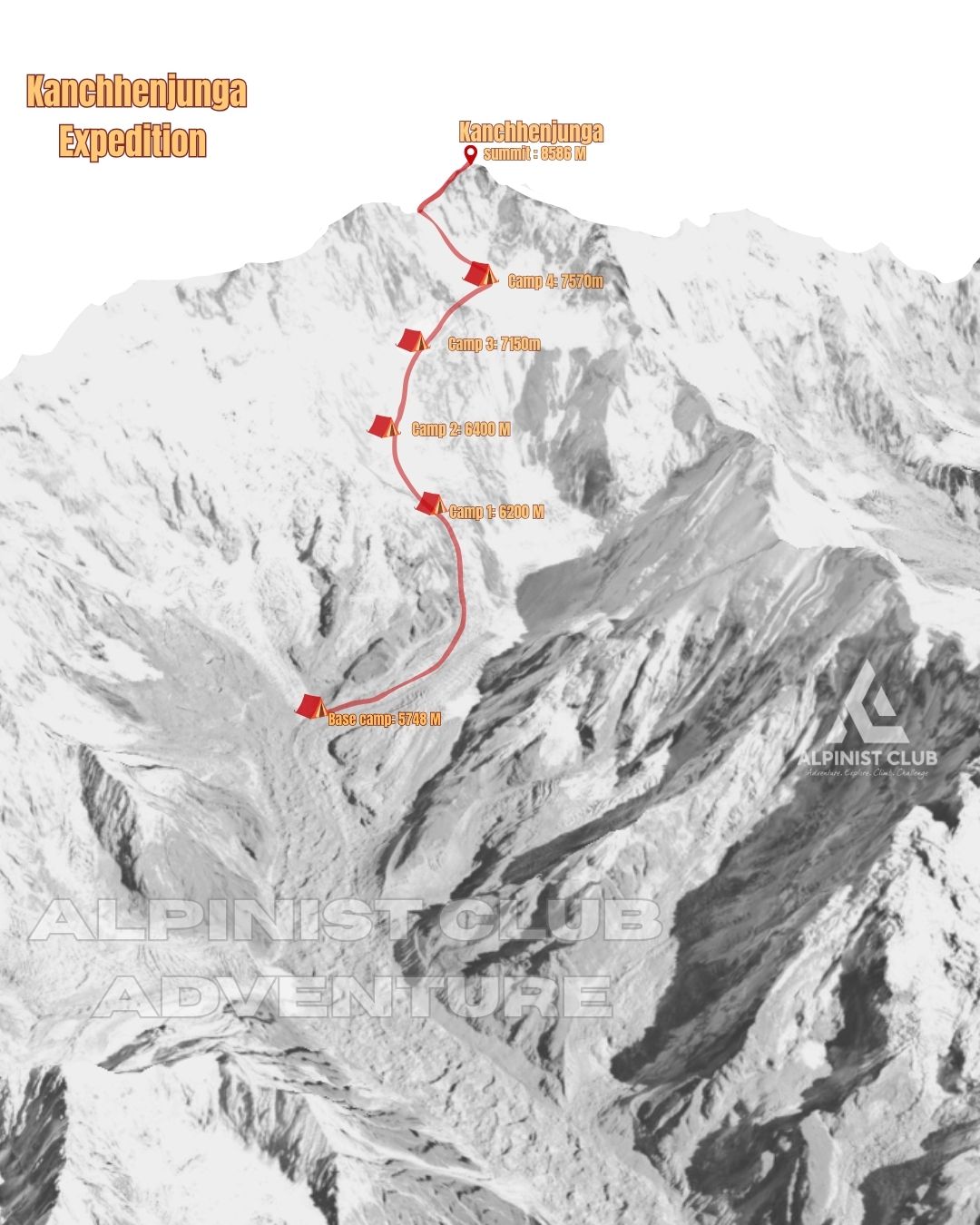
      The ascent requires the establishment of four high camps:
      Base Camp: 5,475 m (Yalung Glacier)
      Camp 1: 6,200 m
      Camp 2: 6,400 m
      Camp 3: 7,100 m
      Camp 4: 7,550 m

      The route follows the original 1955 British ascent and is divided into three main sections:
      1. Two successive icefalls between 6,000 and 7,000 m (Camps 1–3)
      2. Ascent of the Great Plateau to the base of a major couloir below the west ridge (Camp 4)
      3. Ascent of the couloir followed by a long rising traverse rightward through steep rock below the West Ridge to reach the summit

      The route is exposed to avalanches, both in the icefalls and on the Great Plateau beneath the imposing West Face.

      Base Camp to Camp 1 (6,200 m):
      45° slopes above Base Camp lead to the first icefall. Fixed ropes are required to cross the summit serac. Camp 1 is located on a flat area above it.

      Camp 1 to Camp 2 (6,400 m):
      A descent of about 200 m leads to the main glacier and the second icefall. Approximate distance: 1.5 km, depending on crevasse conditions. Camp 2 is set at the base of the icefall.

      Camp 2 to Camp 3 (7,100 m):
      Long progress through crevasses and seracs toward the Great Plateau. Difficulty varies yearly. Fixed ropes are installed on the steepest sections.

      Camp 3 to Camp 4 (7,550 m):
      A long but relatively easy ascent across the Great Plateau. The slope increases from 15° to 45° near Camp 4.

      Camp 4 to the Summit (8,586 m):
      The most technical and demanding section. The route climbs a major couloir to about 8,250 m on 45–50° snow slopes, then branches right in a rising traverse to steep rock (8,380 m). Several III+ rock sections lead to the West Ridge near a gendarme (8,450 m). A short snow ridge, a rightward traverse, and a chimney at 8,500 m (key passage) lead to the final snow slope and summit.
      Due to the complexity of the face, several variations are possible. The descent requires great caution; the hardest sections are descended by rappel.

      Indicative schedule: departure around 22:00, summit around 09:00; return to Camp 4 ideally by 16:00, often closer to 18:00.

      Meals: Breakfasts and dinners at bivouac – picnic lunches
      Accommodation: Tents


      Helicopter transfer back to the trekking route, avoiding the difficult moraine descent.

      • Altitude: approx. 3,700 m
      • Meals: Breakfast – Lunch – Dinner

      Descent along the Sambuwa Khola.

      • Duration: approximately 5 hrs
      • Elevation gain/loss: +150 m / –1,200 m
      • Altitude: approximately 2,860 m
      • Meals: Breakfast – Lunch – Dinner
      • Accommodation: Lodge 

      We follow the trail along the opposite riverbank through primary forest and “Nepali flat” terrain, then climb steep sandy slopes to Lamite Bhanjyang. After crossing the pass, we ascend through a rhododendron forest. Jannu rises above the treetops before a long descent into the Omje Khola valley.

      • Duration: approximately 5 hrs
      • Elevation gain/loss: +880 m / –1,650 m
      • Altitude: approximately 2,000 m
      • Meals: Breakfast – Lunch – Dinner
      • Accommodation: Lodge 

      A scenic balcony trail through hamlets of bamboo houses decorated with tropical flowers. The heat increases as we descend. After lunch, we cross the agricultural plateau of Pauwa, then climb in zigzags through the forest to Phomphe Danda camp.

      • Duration: approximately 5 hrs
      • Elevation gain/loss: +500 m / –800 m
      • Altitude: approximately 1,740 m
      • Meals: Breakfast – Lunch – Dinner
      • Accommodation: Lodge or tent

      A beautiful day of “Nepali flat” walking through forests, hamlets, and millet terraces. At the Phun Pung viewpoint, we leave the Kabeli Khola valley and head west toward Sinchewa Bhanjyang, a large Gurung village with the Kangchenjunga massif on the horizon.

      • Duration: approximately 6 hrs
      • Elevation gain/loss: +1,000 m / –700 m
      • Altitude: approximately 1,780 m
      • Meals: Breakfast – Lunch – Dinner
      • Accommodation: Lodge or tent

      Final trekking day through rural landscapes. We follow inter-village trails to Lali Kharka, then tackle the final climb through the forest to Deorali Pass (2,600 m), followed by an easy descent to Suketar.

      • Duration: approximately 7 hrs
      • Elevation gain/loss: +780 m / –1,180 m
      • Altitude: approximately 2,440 m
      • Meals: Breakfast – Lunch – Dinner
      • Accommodation: Lodge

      Early departure for the long drive to the Terai plains.

      • Transport: Private vehicle
      • Duration: approximately 10 hrs
      • Altitude: approximately 380 m
      • Meals: Breakfast – Lunch – Dinner
      • Accommodation: Lodge

      Transfer to Bhadrapur airport and one-hour “mountain flight” back to Kathmandu, arriving around midday. Free afternoon and evening.

      • Transport: Private vehicle and flight
      • Duration: approximately 2 hrs drive, 1 hrs flight
      • Altitude: approximately 1,300 m
      • Accommodation: Lodge

      Free day (can be used as a buffer day in case of delays during the trek).

      • Altitude: approximately 1,300 m
      • Accommodation: Hotel

      Transfer to Kathmandu airport according to the international flight schedule.

      • Transport: Private vehicle
      • Duration: approximately 1 hrs

      Everest Very High altitude Note:

      If you have a private group and prefer a personalized experience, we can organize a custom trip tailored to your requirements and group size, running it any day you choose.

      Plan a Private Trip

      Included & Excluded

      Included Points

      ARRIVAL AND DEPARTURE : Airport - Hotel transfers – Airport (Pick Up and Drop), by private vehicle.
      HOTEL ACCOMMODATION IN KATHMANDU : 4-night hotel in Kathmandu (4-star category) - single room on bed with breakfast plan.
      WELCOME DINNER : One Welcome Dinner in a tourist standard restaurant in Kathmandu with Office Staff.
      PERMITS : Expedition Royalty and a permit fee from the Nepal Government to climb Mt. Everest, Sagarmatha National Park, and Pasang Lhamu Rural Municipality entry permit and fee.
      KHUMBU ICEFALL FEE : Khumbu Icefall climbing charge to (SPCC) Sagarmatha Pollution Control Committee.
      LIAISON OFFICER : 1 Government Liaison officer with full equipment, salary, and accommodation.
      GARBAGE MANAGEMENT : Stool Shipment Transfer and Garbage Deposit Fees.
      INSURANCE : Medical and Emergency rescue Insurance for all involved Nepalese staff during the trek and expedition.
      MAP : Trekking and climbing map.
      DUFFLE BAG : One Alpinist club Duffle Bag.
      MEMBER TRANSPORTATION : (Domestic Flight) Fly from Kathmandu – Lukla and while returning, Lukla - Kathmandu, as per itinerary.
      EXPEDITION STUFFS TRANSPORTATION : All necessary expedition equipment transportation for all Members and Staff from Kathmandu to Lukla (by air cargo) to Base camp (by Porters / Yak) – While returning: Base camp to Lukla (by porters / Yak) and Lukla to Kathmandu (by air cargo). Based on the condition expedition staff may transfer by land (KTM-Phaplu) or Heli (KTM-Lukla).
      MEMBER LUGGAGE : Up to 50 Kg per member for personal baggage during the trek to be carried by porters or Yaks.
      FOOD AND LODGING : 3 meals a day (breakfast, lunch, and dinner; including tea and coffee) along with accessible accommodation at the hotel/Lodge during the trek and at the Basecamp. Hygienic and fresh green vegetables, fresh meat, fruits, soft drinks, and juice will be served regularly during the entire expedition using helicopter flights. Well-managed base camp set up for members and Staff.
      PORTER : Porters per member up to the basecamp and from the basecamp (both ways).
      BASE CAMP STAFF : Experienced and well-trained Base Camp Cook and kitchen helpers as required.
      STAFF SALARY AND ALLOWANCE : All Nepalese staff and porters’ daily wages, salary, equipment, food, and clothing.
      BASE CAMP TENT : Each member will have an individual box tent in Base Camp.
      BASE CAMP EQUIPMENT : Single Tent, foam mattresses and pillow per member, 1 Dining Tent, 1 Kitchen Tent, 1 Communication tent, 1 Toilet & 1 Shower Tent, 1 Staff Tent, 1 Tent for Nepalese base camp staff, Store tents, Tables and chairs, and all necessary cooking gears.
      HEATER : Heater at base camp in each Dining and other necessary camps.
      SOLAR/GENERATOR/LIGHT : 1 Solar panel and Generator for lights at base camp, battery charge, laptop and other electronic devices.
      MEDICAL CHECKUP : Twice Medical checkup of each climber at the base camp before the summit attempt.
      TRAINING : Oxygen, Mask Regulator, Ice wall, and Ladder training at Basecamp by UIAGM Guide.
      HIGH ALTITUDE CLIMBING SHERPA : 1 veteran and government-licensed climbing Sherpa per member (1 Member: 1 Sherpa), during the entire climb from Basecamp to the summit and back, and on each rotation.
      ASSISTANCE : Climbing Sherpa to assist in carrying your gear to the high camps.
      CLIMBING SHERPA SALARY & ALLOWANCE : Climbing Sherpa Salary, Equipment, Food, and Clothing.
      BONUS : Carry Bonus of Sherpas and Route Fixing Charges.
      OXYGEN BOTTLE (O2):Summit Oxygen cylinder : 5 oxygen bottles (4 ltrs.) for each member and 3 oxygen bottles for each high-altitude Sherpa. **
      OXYGEN MASK & REGULATOR : 1 Set of Summit Oxygen masks and regulators for each member and high-altitude Sherpa. **
      BACK-UP OXYGEN : BACK-UP Oxygen Cylinder, mask, and regulator (with appropriate charge).
      HIGH CAMP SERVICE (INFRASTRUCTURE AND LOGISTICS) : High Altitude Tent, Necessary cooking EPI gas, cooking pot, High food for a member, Sherpa, and other crews at (C1) (C2) (C3) and (C4). Group climbing gears, fixed, and dynamic rope during the climbing period as required.
      HIGH CAMP KITCHEN AND DINING : We will have one cook, kitchen, and dining tents in Camp I and Camp II.
      HIGH ALTITUDE TENT : Members will share tents in high camps (2 members: 1 tent).
      ROPE FIXING TEAM : The team of experienced Sherpas will fix the route to the summit of Everest (no extra charge will be applied to members).
      SATELLITE PHONE : SATELLITE PHONE for emergency communication carried by Sherpa, also available for members with appropriate charge.
      WALKIE-TALKIE : Walkie–Talkie for communicating from Base Camp to Mountain and Mountain to Base Camp.
      PERMITS : Satellite Phone/walkie-talkie permit for all members and staff.
      INTERNET SERVICE : Internet facility (1 Mbps) will be available at the Base Camp (subject to a charge).
      WEATHER FORECAST : Weather forecast report regularly during the entire expedition.
      MEDICAL KIT : Medical kit for members and staff.
      SUMMIT BONUS : Summit bonus for climbing Sherpa- Minimum 1800 USD.
      CERTIFICATE : Kanchenjunga climbing certificate after climbing successfully.

      Excluded Points

      AIR FARE : International flight airfare (from and to Kathmandu).
      NEPAL ENTRY VISA FEE : The Nepalese Visa fee is $125 USD for 90 Days.
      LUNCH & DINNER : Lunch and dinner during the stay in Kathmandu (also in case of early return from Trekking / Expedition than the scheduled itinerary).
      EXTRA NIGHTS IN KATHMANDU : Extra nights’ accommodation in Kathmandu. In case of early arrival or late departure, early return from Trekking / Expedition, or domestic flight cancellation (due to any other reason) than the scheduled itinerary.
      INSURANCE POLICY : Insurance covering both medical and high-altitude evacuation costs (for the trip cancellation, interruption, high-altitude rescue and air evacuation, medical treatment, repatriation, etc.) *Mandatory
      PERSONAL EXPENSES : Telephone Calls, Internet, Toiletries, battery recharge, hot shower, laundry, soft drinks, beers, and any Alcoholic beverages (during the trek and in Kathmandu, but we will have soft drinks for members at base camp).
      PERSONAL CLIMBING EQUIPMENT : Clothing, Packing Items, Bags, Personal Medical Kit, and all kinds of Personal Trekking / Climbing Gear.
      TOILETRIES : Soaps, shampoos, toilet and tissue papers, toothpaste, and other items used to keep yourself clean.
      FILMING : Special Filming, Camera, and Drone permit fee.
      INTERNET SERVICE : Not included during the trek.
      TIPS : Calculate some tips for basecamp and high camp staff – Minimum 400 USD.
      EXTRA : Any other services or activities, which are not mentioned in the itinerary, and other items not listed in the “Cost Includes” section.

      Trip Information

      KANCHENJUNGA EXPEDITION DETAILS 

      Your guide, from your arrival in Kathmandu until your departure, is responsible for the success of your trip and oversees your team. Do not hesitate to ask him questions, respect his position as the team leader, and above all follow his advice! Often your guide is the only English-speaking member of the team. In the mountains and, especially when during high-altitude travels, your guide is responsible for the safety of the group. The instructions he gives and the remarks he makes to all participants must be carefully followed. The interest and safety of the trekking group must be preserved, even when it may be to the detriment of an individual member of the group.

      Read More
      YOUR PRIVATE GUIDE DURING CLIMBING KANCHENJUNGA
      The keystone of your success on all of our expeditions is that we are systematically on a ratio of one high-altitude sherpa per participant. He accompanies you for the key moments of the ascent and during the summit push. He is particularly experienced in high altitudes. He has participated in several expeditions at more than 8,000 meters, successfully leading participants to the summit. We select him for you. He is generally English-speaking. He may not be permanently at your side in the rotations between the camps, his role also being to carry out the portages to set up the camps.

      There is a summit bonus for your high-altitude sherpa to be paid on-site in cash after the climb. This bonus is due from the moment you leave the last camp towards the summit during your summit push attempt. 

      EXPEDITION LEADER IN KANCHENJUNGA
      His role is important in leading the strategy necessary for success: rotation in the altitude camps, acclimatization of each participant, and study of weather reports to decide on the optimum moment to launch the summit push.

      The expedition leader represents the Alpinist Club to the group, . Mainly based at the base camp, he can accompany you to the high-altitude camps to supervise the smooth running of the expedition's logistics. He makes the necessary decisions that may be required. His authority is preponderant and unavoidable. You must respect his decisions as well as those taken collectively.

      LOCAL PORTER TEAM DURING THE KANCHENJUNGA EXPEDITION
      Our experienced team is uniquely equipped to address the key challenges of a Himalayan expedition: technical supervision and equipment transport. With over 10 years of refinement, our optimized operation assigns clear roles to ensure individual and collective success.

      A kitchen team will be present at the Kanchenjunga base camp.
      There is a team of porters who help us set up the base camp with all the equipment and the kitchen. Beyond that, the team of high-altitude sherpas takes over. They help us in particular in setting up the high altitude camps and in portaging from the base camp.

      Each participant will have to take care of carrying their personal belongings and altitude food. The collective equipment is transported by the Nepalese team. Our backpack will be calibrated from 10 to 12 kg.

      For unforeseeable reasons at this stage, including weather but also fitness or lack of fitness of the participants, your guide may have to adapt or even interrupt your program, at any time if he deems it necessary, whether for the whole group or for a few participants, and for the smooth running of your trip. He remains the sole judge and guarantor of your safety.

      KANCHENJUNGA CLIMBING  DIFFICULTY LEVEL 

      1: Physical level: extreme

      This program is aimed at very experienced participants, with the physical and mental condition of a high-level athlete.
      It is given as "extreme difficulty" given the very high altitude at which you will be climbing. Manaslu is one of the highest mountains in the world: although the technical difficulties are relative, climbing the summit is nonetheless a difficult and sometimes even dangerous undertaking. The commitment is very pronounced during summit attempts.

      This expedition is therefore intended for experienced mountaineers (comfortable in a PD/AD level in snow), who already have good experience of high altitude. It is essential to be totally autonomous in the mountains, both technically and psychologically. The expedition leader and the high-altitude sherpas are above all technical advisors and logistics managers. They cannot under any circumstances "pull" a participant to the summit.
      of course, training is necessary, training focused on developing one's endurance and resistance capacities: running, cycling, swimming, ski touring and of course, mountain racing. This training must be regular and have started at least 6 to 8 months before the expedition leaves.

      2: High Altitude 

      High altitude is the main challenge in climbing an 8,000-meter peak, as oxygen levels drop significantly (hypoxia). Gradual acclimatization is vital, especially in the first weeks. Take it slow, avoid overexertion, and listen to your body—symptoms like headaches and nausea are common but shouldn’t be ignored to prevent serious complications.

      The expedition demands prolonged physical effort in harsh conditions, including cold and wind, so solid endurance and resistance training are essential. For those interested, we offer the option to climb without supplemental oxygen, though most use it from Camp 4 (7,570 m). A 1:1 ratio of altitude Sherpas to participants ensures personalized support during the summit push. Feel free to discuss your plans with us!

      During the expedition, you must carry your personal belongings, as high-altitude Sherpas only transport collective equipment. For summit attempts, expect to carry a 6–8 kg bag, including oxygen bottles (4 kg).

      The challenging environment—distance, cold, bad weather, and discomfort—can cause stress, fatigue, and mood changes. Good humor, tolerance, and respect for teammates and the local team are essential. While subgroups may form, team spirit is key to success.

      3: Mountaineering level 

      This program requires the use of mountaineering equipment like crampons, harnesses, ice axes, and ropes. The route may include moderate challenges, such as steeper glacier sections, exposed walls, or sustained effort, all made harder by the altitude. Steep sections are equipped with fixed ropes, so proficiency with a self-blocking device is essential. This climb is for participants with prior mountaineering experience at a similar level.

      The technical difficulty assumes normal weather conditions and can increase with poor weather, fresh snow, or low-quality ice. Factors like altitude, heavy packs, limited route equipment, and long approaches also make the climb more demanding.


      ACCOMMODATION IN KATHMANDU AND DURING THE KANCHENJUNGA EXPEDITION
      • Hotel In Kathmandu: In Kathmandu, we will provide you with a single room in a hotel 
      • During the trek to Kanchenjunga: You will stay in the Lodge. Lodges in Nepal are very random in terms of comfort. Lodges can look like a refuge or sometimes a homestay. They are mostly family homes with double, triple, or dormitory rooms. Toilets and showers are always separate. 
      • Kanchenjunga Base Camp: At the base camp, we are in individual tents. A base camp for several weeks must be as comfortable as possible, to allow a good recovery on returning from the high-altitude camps. It must allow us to face a period of bad weather in the best possible conditions. Each participant has a tent with a comfortable mattress. A heated mess tent is the main living area. Tables and chairs are permanently installed there. We also have a shower tent and a toilet tent (solid waste in evacuated barrels)
      • kanchenjunga High Altitude Camps: During the ascent, at the high camps, we have a high-altitude tent for 2 people, or even 3 people at the last camps.
      Hygiene & dry cleaning during the Kanchenjunga Expedition

      • Toilets: The base camp has toilets and toilet paper. Be sure to wash your hands with hydroalcoholic gel (to be taken from your personal pharmacy) after each visit to the toilet. For the higher camps, we recommend that you bring a bottle that you will use to urinate at night to avoid having to go out.
      • Daily hygiene: a basin with water and soap is available at the entrance to the mess tent. Water is intended for washing the face and hands, do not drink it.
      • Shower: hot water is available (ask in the kitchen). Only take showers in sunny weather to avoid catching a cold! 
      • Laundry: water (cold) and basin to be requested from the kitchen, bring biodegradable products only.

      MEAL IN  KATHMANDU AND TREKKING DURING KANCHENJUNG EXPEDITION
      Upon arrival in Kathmandu, a welcome dinner is provided on the first evening. Similarly, upon return from the expedition, a farewell meal is provided. In the cities, many small (or large) restaurants allow us to discover the typical local cuisine. 

      During the Trek: breakfasts and evening meals are prepared by the kitchen team or the lodge cooks and are taken in the lodge dining room or under the mess tent. Depending on the profile of the stages (length of the day's walk and/or presence of water), midday Lunch/ snacks will be served hot or cold in the form of picnics.

      Here is a typical one-day menu during the trek: 
      • Breakfast: eggs, toast or chapati, or Tibetan bread or pancakes, or pancakes, butter/jam, tea or coffee
      • Lunch: a main course, tea or coffee
      • Dinner: soup, main course, fruit (fresh or canned), tea or coffee.  During the trek, tea or coffee is served with meals. Two cups per person are included. Apart from these included menus, other drinks and foodstuffs will be at your expense.
      • Water: Use purification tablets (Hydralazine, Micropur, or others) as advised by your guide, refill with purified water when possible, and avoid bottled mineral water due to its environmental impact.
      BASE CAMP MEAL: All meals are prepared by the kitchen team using local ingredients including rice, pasta, lentils, potatoes, vegetables, eggs, a little meat, etc. They are served to you in a Dinning tent. Non-alcoholic hot drinks such as tea or coffee are offered to you at will. We recommend that you stay constantly hydrated. 
      ALTITUDE CAMPS MEAL: at camp 2 our cook will prepare food for you. At high altitudes, eating can be difficult, and freeze-dried food is usually necessary. While this food might taste fine at lower elevations, it can quickly become unappealing in high-altitude camps.

      we will provide freeze-dried dishes and share your preferences. We’ll do our best to match these, depending on available stock. You can also bring up your favorite foods for the expedition.

      for higher camp, Each tent is equipped with a stove to melt snow for water, prepare freeze-dried meals, and make hot drinks. Gas cartridges will be provided

      STAY HYDRATION: Bring water purification tablets (like Hydroclonazone or Micropur) to treat water, depending on the source and your guide's advice. Purified water may sometimes be available, reducing the need for bottled water, which is less eco-friendly. 

      Glacier meltwater lacks minerals, which your meals partly provide. However, relying only on tea, coffee, or plain water can lead to poor hydration, stomach issues, and mineral deficiencies on long expeditions. To avoid this, pack 2–3 tubes of mineral salt tablets (10 tablets per tube) to add to your water bottle.

      TRANSFERS / TRANSPORT DURING TRIP
      All transfers are provided in private vehicles. 
      For various reasons, we prefer trekking to reach the base camp: the progression designed for acclimatization allows you to prepare yourself physically and psychologically for the climb. It is also the ideal time to get to know the team and to start building team spirit and cohesion.  The return is also planned as a trek. That said, the possibility of taking the helicopter on the way back is possible for an additional fee. 

      GROUP SIZE  IN KANCHENJUNGA EXPEDITION
      The group is composed of 1 to 15 participants maximum. The number of participants is voluntarily limited to allow a better immersion, to not embarrass our hosts, to develop spaces of freedom and to allow a great flexibility of operation. However, the maximum number can be exceeded in the case where the last person who registers wishes to travel with another or several other people. The services will not be modified and the conditions of the trip will be identical as a result.

      COLLECTIVE CAMP EQUIPMENT
      All logistical equipment is provided, including individual tents at the base camp with mattresses, mess tent, shower tent and toilet tent, as well as all collective and individual cooking equipment. At altitude, tents, stoves with gas cartridges, ropes and anchors.

      INDIVIDUAL EQUIPMENT
      Personal equipment is not provided. A complete list is provided later in this document. It will be refined with us during the preparation days and up until the time of departure according to your questions.
      High altitude sleeping bags, full suits and/or good quality down jackets are expensive items that you may not use often. We can rent you this specific equipment for the duration of the expedition. You must then return the equipment cleaned and in the condition in which it was given to you (deposit required). 

      OXYGEN OR WITHOUT OXYGEN FOR SUMMIT PUSH
      For safety, high-altitude Sherpas always use supplemental oxygen at a reduced flow. Most participants begin using oxygen from Camp 4 (7,400 m), with some starting at Camp 3 (6,800 m). Your package includes 3 oxygen bottle and 1 regulator, and a mask for use from Camp 4. High-altitude porters transport these items to the camps.

      If you wish to use oxygen before Camp 4, you must request it early. Extra cylinders are not included and must be paid for on-site. We also allow participants to attempt the summit without supplemental oxygen, thanks to a 1:1 Sherpa-to-climber ratio, enabling personalized ascent rhythms. Discuss this option with your expedition leader early to refine acclimatization. Note that no refunds are provided if you choose not to use oxygen. For safety, one oxygen bottle per participant is provided at Camp 4, regardless of use.

      From Camp 4, two options are available for the summit push:
      No oxygen bottle: The "purist" approach avoids extra weight but requires turning back if fatigue or slow pace becomes an issue. No second summit attempt is allowed.
      Carry an oxygen bottle: Adds 4–5 kg to your pack but allows flexibility to use oxygen if needed during the climb.

      SECURITY AND COMMUNICATION
      We have at least one Iridium satellite phone that is used only for logistical, weather and security purposes. Under certain conditions, participants may use it. For these private uses, please contact us.
      The camps will be permanently connected by radio. Expedition leader, participants and high-altitude sherpas will also have access to this. 
      The expedition will have a hyperbaric chamber at the base camp, and a complete, lighter pharmacy at the higher camps.

      PREPARATION FOR KANCHENJUNGA EXPEDITION
      Preparing for the trek requires several months of preparation with 4 to 6-hour walks every weekend for stamina and participating in a sport that requires short periods of high exertion.

      MEDICAL CHECK-UP BEFORE GOING EXPEDITION
      Being in good health is essential to enjoy your Alpinist Club trip fully. If your last medical visit was more than four years ago, please get another general physical exam and tell your doctor the nature of your trip (climate, altitude, difficulty, etc.). The altitude also has the effect of reviving dental problems or other chronic pain, so getting a dental checkup is also prudent. If you are undertaking a high-altitude expedition, we advise you to consult a mountain medicine specialist.

      ACUTE MOUNTAIN SICKNESS
      This trip takes place at high altitudes so some people may experience altitude-related discomforts like headaches, loss of appetite, and swelling of limbs. Most of these symptoms usually go away within a few days, but sometimes they can develop into a serious illness: pulmonary or cerebral edema. There are no preventive drugs for AMS. Diamox diuretic is often effective for symptomatic relief, but you should first check with your doctor to verify that it is not contraindicated. Think about it before you go.
      Less More
      Gears List

      Trip Map

      Map Image

      Kangchenjunga stands at 8,586 meters (28,169 feet), making it the third-highest mountain in the world.

      The mountain is located on the border between Nepal and the  Sikkim.

      The primary routes are the Southwest Face (Nepal side) and the Northeast Ridge (Sikkim/India side).

      Yes, climbers should have prior experience in high-altitude mountaineering and technical climbing skills.

      The optimal climbing seasons are typically pre-monsoon (April to May) and post-monsoon (September to October).

      Challenges include steep ice walls, crevasses, unpredictable weather, and high altitude.

      Yes, climbers require special permits for both the trek and the ascent, which can be obtained through trekking agencies.

      Climbers should be in excellent physical condition, with endurance training recommended for high-altitude treks.

      Yes, it’s important to respect local customs and traditions, particularly due to the sacred significance of Kangchenjunga.

      Essential gear includes high-altitude climbing equipment, warm clothing, technical gear (ice axes, crampons), and safety equipment.

      The entire expedition can take 4 to 6 weeks, including trekking to the base camp and acclimatization.

      Yes, altitude sickness is a significant risk; proper acclimatization is crucial to mitigate this risk.

      The base camp offers stunning views, a chance to acclimatize, and preparation for the ascent. Amenities are basic, typically consisting of tents.

      The success rate varies, but it is lower compared to other 8,000-meter peaks due to its technical challenges and weather conditions.

      Yes, trekkers often have opportunities to engage with local communities

      Send Review