


Overview
From Everest to Makalu via the Sherpani Col at 6180 meters
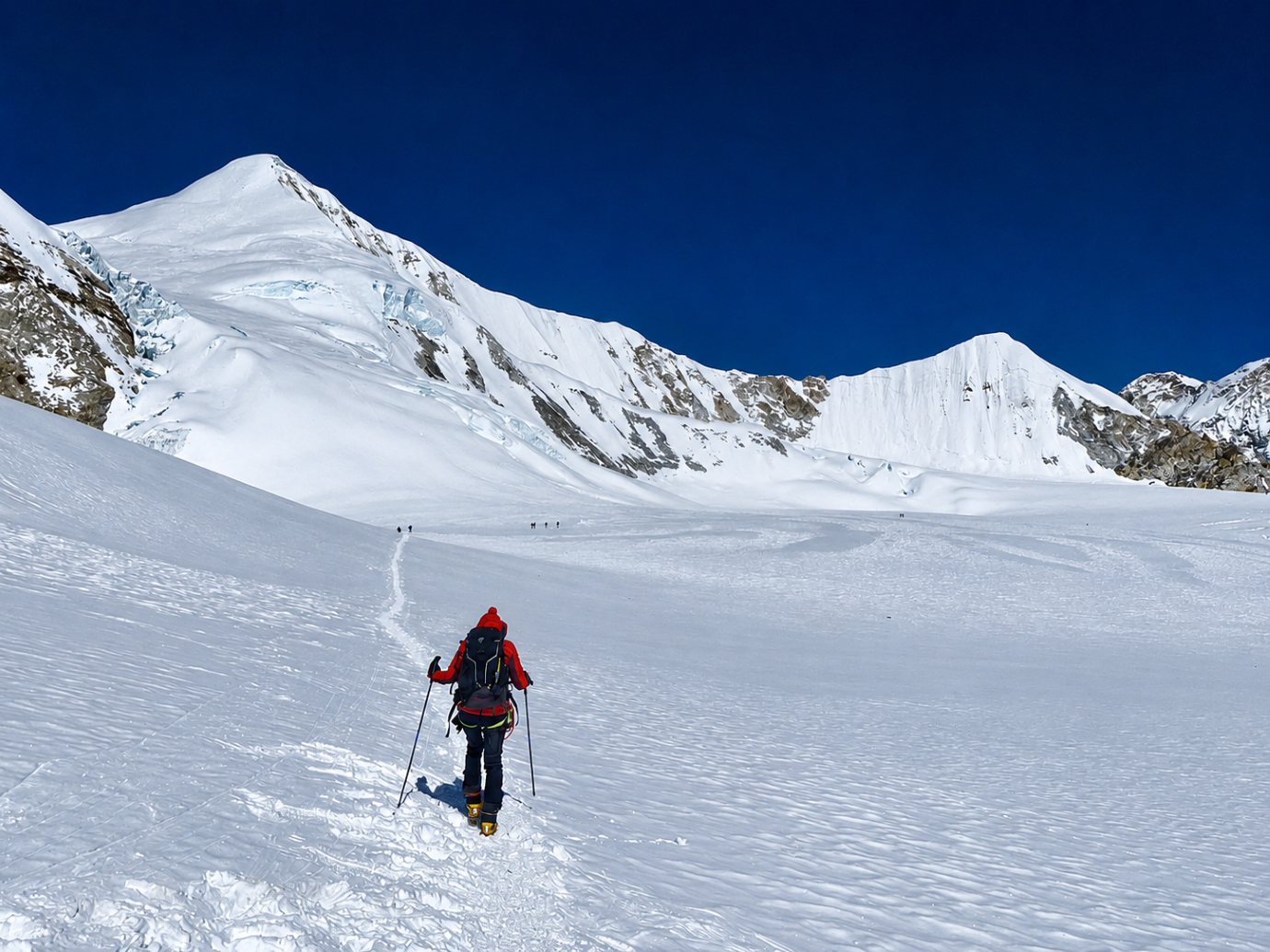
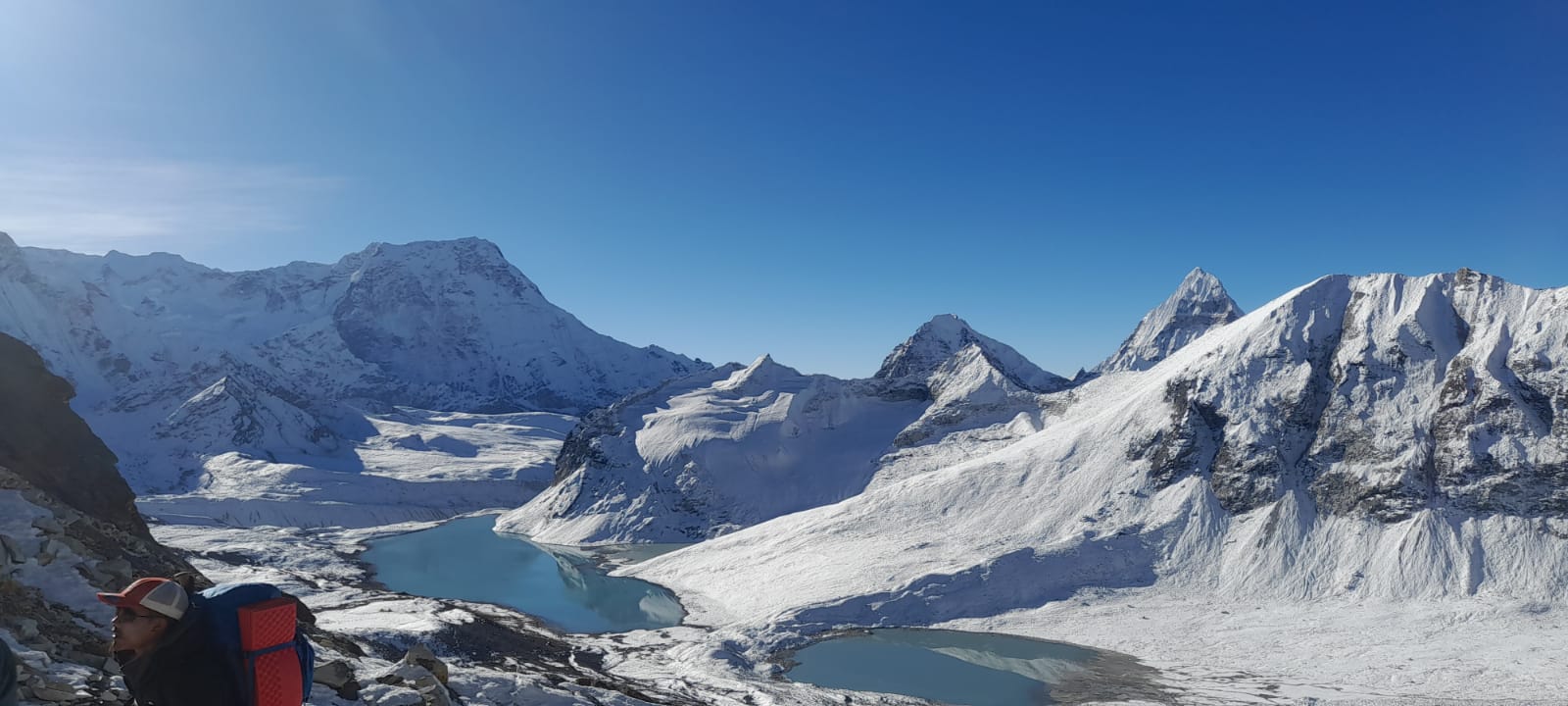
The route crosses three major high-altitude passes, each requiring technical skill, endurance, and solid alpine experience. We begin with Amphu Laptsa (5,850 m), a steep and often icy pass that marks our transition into serious mountaineering terrain. From there, the challenge intensifies with the crossing of the West Col (6,143 m), first climbed by the legendary Eric Shipton in 1951. This historic passage remains a true Himalayan classic, involving glacier travel, snow slopes, and complex route-finding.
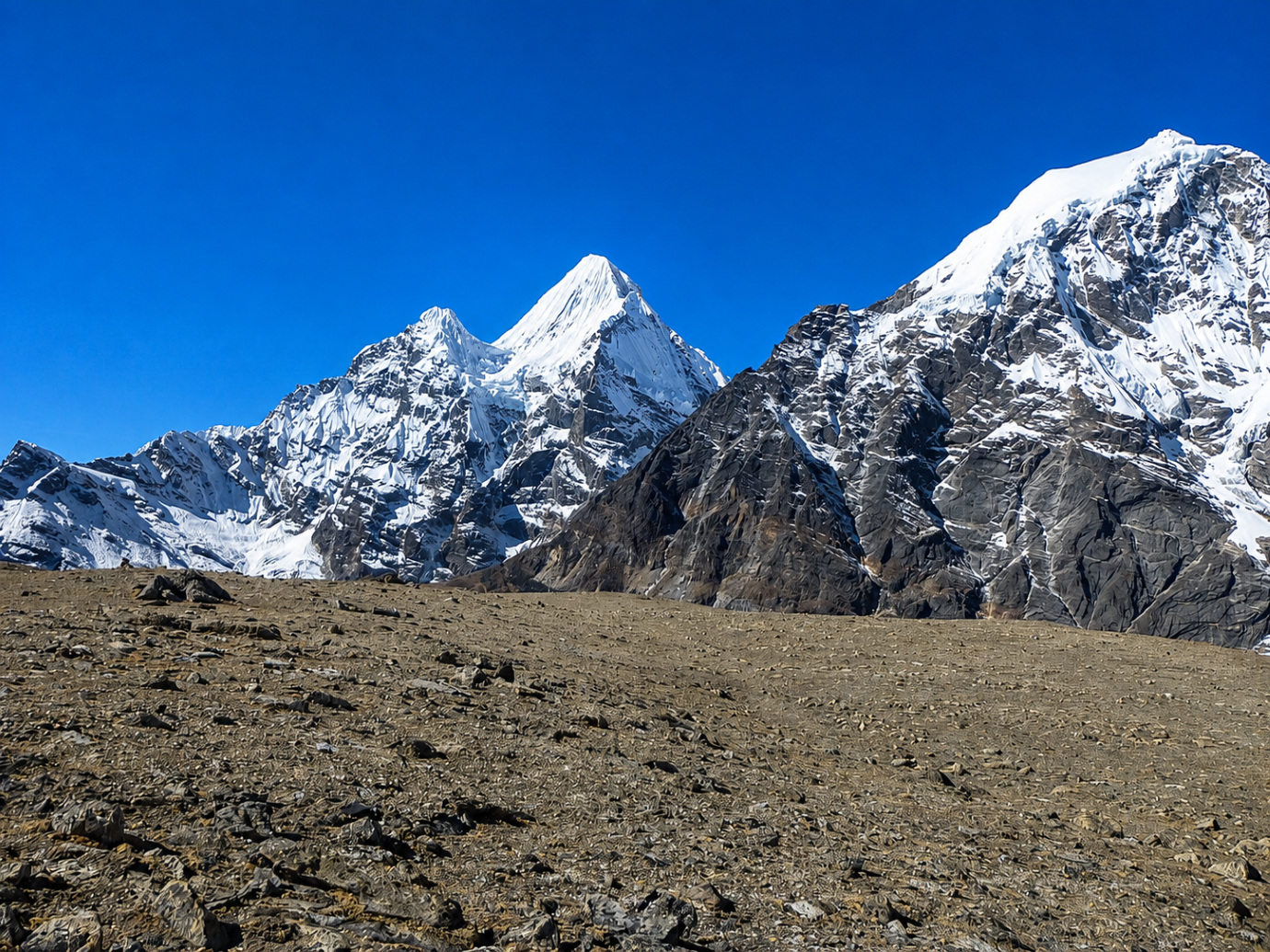
The third pass, Sherpani Col (6,135 m)—an alternative to the more technical East Col—provides access to the remote Makalu region. Although considered slightly less technical, it remains a serious high-altitude crossing, often requiring fixed ropes, roped glacier travel, and rappels to negotiate steep sections safely. Throughout the expedition, we move through an immense landscape of ice, snow, and high glacial basins, skirting the flanks of towering Himalayan giants in total isolation.
The reward for these demanding efforts is extraordinary. After crossing Sherpani Col, we descend to Makalu Base Camp, set beneath the world’s fifth-highest mountain, surrounded by some of the wildest scenery in the Himalaya. The return journey follows the historic Shipton Trail, an elegant and remote route that completes this epic traverse.
This expedition is not a trek—it is a true Himalayan adventure, combining technical mountaineering, historical routes, and extreme high-altitude exploration for those seeking one of Nepal’s most elite and unforgettable challenges.
Everest to Makalu Trek via Amphu Laptsa, West Col and Sherpani Col – 23-Day Itinerary
Day | Itinerary | Altitude |
|---|---|---|
01 | Arrival in Kathmandu | 1,350 m |
02 | Expedition preparation, briefing and equipment check in Kathmandu | 1,350 m |
03 | Fly from Kathmandu to Lukla and trek to Phakding | 2,610 m |
04 | Trek from Phakding to Namche Bazaar | 3,440 m |
05 | Trek from Namche Bazaar to Khumjung | 3,790 m |
06 | Trek from Khumjung to Phortse | 3,810 m |
07 | Trek from Phortse to Pangboche | 3,985 m |
08 | Trek from Pangboche to Dingboche | 4,410 m |
09 | Trek from Dingboche to Chukhung | 4,730 m |
10 | Acclimatization and rest day in Chukhung | 4,730 m |
11 | Trek from Chukhung to Amphu Laptsa Base Camp | 5,400 m |
12 | Cross Amphu Laptsa Pass (5,845 m) and descend to East Base Camp | 5,400 m |
13 | Trek from East Base Camp to Baruntse Base Camp | 5,400 m |
14 | Cross West Col (6,150 m) and continue to Baruntse High Camp | 5,700 m |
15 | Cross Sherpani Col (6,180 m) and descend to Sherpani High Camp | 5,700 m |
16 | Trek from Sherpani High Camp / Swiss Camp to Makalu Base Camp | 4,870 m |
17 | Explore Makalu Base Camp via Moraine (5,350 m) and Makalu Pattar (5,795 m), return to Base Camp | 4,870 m |
18 | Trek from Makalu Base Camp via Langmale Kharka to Yangri Kharka | 3,557 m |
19 | Trek from Yangri Kharka to Dobato | 3,860 m |
20 | Cross Keke La (4,185 m) and Shipton La (4,216 m), descend to Khongma Danda | 3,500 m |
21 | Trek from Khongma Danda to Seduwa | 1,500 m |
22 | Trek from Seduwa via Arun River (735 m), trailhead (1,060 m) and Num (1,560 m), then drive to Tumlingtar | 400 m |
23 | Fly from Tumlingtar to Kathmandu | 1,350 m |
Itinerary
Expand All- Transfer to hotel
- Final altitude: approximately 1,350m
- Meals: Dinner
- Accommodation: night in the hotel
- Meals: breakfasts – free lunches (not included) – free dinners (not included)
- Accommodation: nights at the hotel
- flight about 25 minutes
- about 3 hours of trek
- Altitude gain / loss: + 100 m / - 300m
- Final altitude: approximately 2,610m
- Meals: breakfast – lunch – dinner
- Accommodation: night in lodge
- 6 hours of trek
- Altitude gain/loss: + 1,000 m / - 350 m
- Final altitude: approximately 3,440m
- Meals: breakfast – lunch – dinner
- Accommodation: night in a lodge
- 3 hours of trek
- Altitude gain/ loss: + 420 m / - 20 m
- Final altitude: approximately 3,780m
- Meals: breakfast – lunch – dinner
- Accommodation: night in a lodge
- 3 hours OF trek
- Altitude gain/ loss: + 220 m / - 180 m
- Final altitude: approximately 3,810 m
- Meals: breakfast – lunch – dinner
- Accommodation: night in a lodge
- 5 hours trek
- Altitude gain/loss: + 450 m / - 150 m
- Final altitude: approximately 3,960 m
- Meals: breakfast – lunch – dinner
- Accommodation: night in a lodge
- 5 hours trek
- Altitude gain/ loss: + 400 m / - 100m
- Final altitude: approximately 4,400 m
- Meals: breakfast – lunch – dinner
- Accommodation: night in a lodge
- 5 hours trek
- Final Altitude: approximately 4,730 m
- Meals: breakfast – lunch – dinner
- Accommodation: night in a tent or lodge
- Approximately: 4,730 m
- Meals: breakfast – lunch – dinner
- Accommodation: night in a tent or a lodge
- 5 hours trek
- Altitude gain: + 650 m
- Final altitude: approximately 5,300 m
- Meals: breakfast – lunch – dinner
- Accommodation: night in a tent
- 7hrs of trek
- Altitude gain/loss: + 650 m / - 400 m
- Final altitude: approximately 5,500 m
- Meals: breakfast – lunch – dinner
- Accommodation: night in a tent
- 6 hours trek
- Altitude gain/loss: + 250 m / - 300 m
- Final altitude: approximately 5,430 m
- Meals: breakfast – lunch – dinner
- Accommodation: night in a tent
- 6 hours trek
- Altitude gain/loss: + 750 m / - 100 m
- Final altitude: approximately 6,100 m
- Meals: breakfast – lunch – dinner
- Accommodation: night in a tent
- 7hrs of trek
- Altitude gain/loss: + 200m / - 600 m
- Final altitude: approximately 5,450 m
- Meals: breakfast – lunch – dinner
- Accommodation: night in a tent
- 6 hours trek
- ALtitude gain/ loss: + 250 m / - 850 m
- Final Altitude: approximately 4,850 m
- Meals: breakfast – lunch – dinner
- Accommodation: night in a tent
- 6 hours trek
- Altitude gain/loss: + 1000 m / - 1000 m
- Final altitude: approximately 4,850 m
- Meals: breakfast – lunch – dinner
- Accommodation: night in a tent or lodge
- 5 hours trek
- Altitude gain/loss: + 100 m / - 1,400 m
- Final altitude: approximately 3,530 m
- Meals: breakfast – lunch – dinner
- Accommodation: night in a tent or lodge
- 4 hours tent
- Altitude gain/loss: + 630 m / - 300 m
- Final altitude: approximately 3,860 m
- Meals: breakfast – lunch – dinner
- Accommodation: night in a tent or lodge
- 6 hours trek
- Altitude gain/loss: + 630 m / - 950 m
- Final altitude: approximately 3,580 m
- Meals: breakfast – lunch – dinner
- Accommodation: night in a tent or lodge
- Altitude gain/loss: + 150 m / - 2,060 m
- Final altitude: approximately 1,670 m
- Meals: breakfast – lunch – dinner
- Accommodation: night in a tent or lodge
- 4 hours drive
- about 3 hours trek
- Altitude gain/loss: + 300 m / - 950 m
- Final altitude: approximately 500 m
- Meals: breakfast – lunch – dinner
- Accommodation: night in guesthouse
- by private vehicle and domestic flight
- approximately 2 hours drive to the airport
- about 35 minutes flight
- approximately 1,300 m
- Meals: breakfast – free lunch (not included) – free dinner (not included)
- Accommodation: night at the a hotel
Note:
If you have a private group and prefer a personalized experience, we can organize a custom trip tailored to your requirements and group size, running it any day you choose.
Plan a Private TripIncluded & Excluded
Included Points
Excluded Points
Trip Information
sherpani col pass trek Details Guide
Your guide, from your arrival in Kathmandu until your departure, is responsible for the success of your trip and oversees your team. Do not hesitate to ask him questions, respect his position as the team leader, and above all follow his advice! Often your guide is the only English-speaking member of the team. In the mountains and, especially when during high-altitude travels, your guide is responsible for the safety of the group. The instructions he gives and the remarks he makes to all participants must be carefully followed. The interest and safety of the trekking group must be preserved, even when it may be to the detriment of an individual member of the group.
Read MoreYour Nepalese Team may include several members, each with specific responsibilities:
- The Guide Leader (Sirdar) is responsible for and is the leader of the whole team and is treated with respect by all. Often he has earned his position by starting as a porter and rising through the ranks.
- Climbing Sherpa: Responsible for fixing ropes, guiding you to the summit, and assisting with technical climbing while carrying essential gear.
- The Cook: is responsible for all meals and is on a trek that doesn’t use lodges for meals. (camping trek )
- The kitchen boy: is an assistant to the cook. ( camping trek )
- The Assistant Guide: is actively helping clients under the leader’s direction and set camp.
- The porter: carries loads for the trekking group, essential in Nepal’s mountainous terrain with limited roads. Regulations ensure a maximum weight limit and a minimum wage for their work. Porters are provided with proper gear based on the trekking route and are insured for alpine treks.
Accommodations in Kathmandu and Sherpani Col pass trekking
- Hotel Himalayan Suit: Located in the heart of Thamel, this hotel is ideal for walking the bustling streets of Kathmandu. The spacious rooms all have a bathroom, air conditioning, and Wi-Fi. A fully equipped and active dining room is available for all meals, and the breakfast buffet offers a wide choice of foods. The hotel offers currency exchange, laundry services, and luggage storage
- Sampada Garden: Located just 20 minutes on foot from Thamel and Durbar Square, this hotel is convenient for exploring Kathmandu. The rooms have all the necessary comforts for your stay: air conditioning, bathroom, and Wi-Fi. Breakfasts are served as a generous buffet. The hotel provides currency exchange, laundry services, and luggage storage.
Accommodation during the Sherpani Col Pass trek
- During the trek lodge: You will stay in the Lodge. Lodges in Nepal are very random in terms of comfort. Lodges can look like a refuge or sometimes a homestay. They are mostly family homes with double, triple, or dormitory rooms. Toilets and showers are always separate. however, the Everest region has good lodges.
- Sherpani col passes Chhukung to Makalu base camp: between these days, you will stay in tents. Since we'll be here for several days, we aim to make it as comfortable as possible to help everyone recover after returning from higher camps and summit. Each 2-person has a 1 tent with a comfortable mattress. There's a heated mess tent where we gather to eat and relax, with tables and chairs set up inside. We also have a shower tent and a toilet tent, where solid waste is collected in barrels for proper disposal
Meal In Kathmandu, Trekking and sherpani col pass expedition
- Breakfast: eggs, toast or chapati, or Tibetan bread or pancakes, or pancakes, butter/jam, tea or coffee
- Lunch: a main course, tea or coffee
- Dinner: soup, main course, fruit (fresh or canned), tea or coffee During the trek, tea or coffee is served with meals. Two cups per person are included. Apart from these included menus, other drinks and foodstuffs will be at your expense.
- Water: We provide water purification tablets. and Recommended to bring refilling bottles with purified water. Avoid buying mineral water due to its environmental impact.