
Max. Elevation









The journey begins in Kathmandu, but the real feeling of the course starts as the road follows the Marsyangdi Valley toward Manang. The busy streets gradually disappear behind you. Villages become smaller, the air becomes colder, and the mountains begin to dominate the horizon. After reaching Humde, at around 3,330 meters, you have time to acclimatize and prepare before stepping onto the ice.
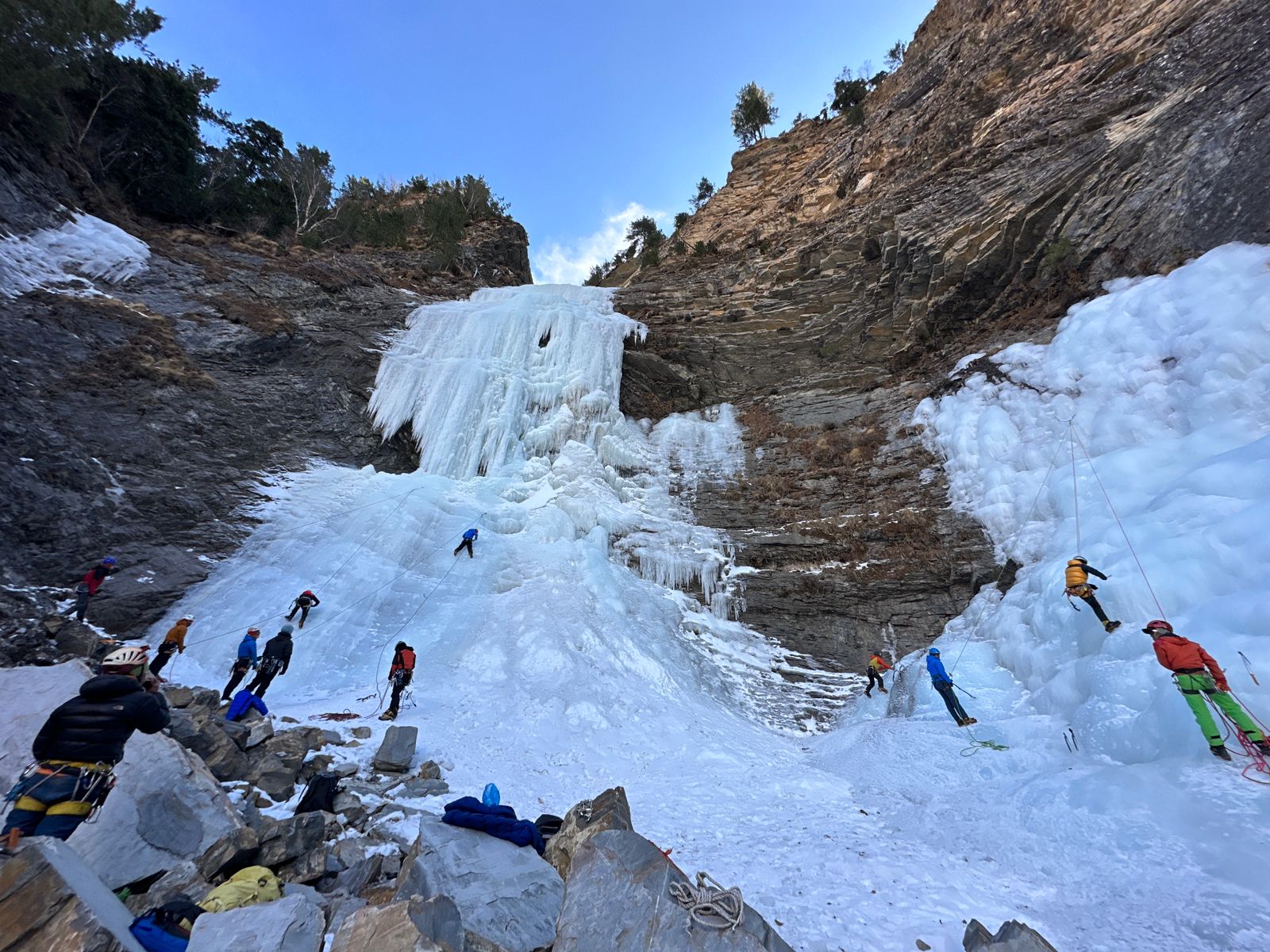
For many participants, the first training day is also their first time standing beneath a frozen waterfall with crampons on their boots and ice tools in their hands. At first, climbing ice can feel unfamiliar. You learn that reaching higher is not simply about pulling harder. Good ice climbing depends on balance, foot placement, efficient movement, controlled tool swings, and confidence in the climbing system.
Training begins with the fundamentals.
Your guide introduces the climbing equipment, explains how it is used, and helps you become comfortable walking and moving on ice. You practice different crampon techniques, ice-tool placement, knots, belaying, and communication before progressing onto steeper terrain.
As the course continues, the skills become more technical. You learn about ice screws, anchor systems, V-threads, rappelling, fixed ropes, rope management, top-rope climbing, and the principles of lead climbing. When your ability, ice conditions, and safety allow, the guide may introduce supervised mock-lead or single-pitch lead-climbing exercises.
The purpose of the course is not simply to climb a frozen waterfall.
It is to understand how and why each climbing system works, develop efficient movement, recognize hazards, and build habits that can support future alpine and mountaineering objectives. No previous ice-climbing experience is required. Good general fitness, an interest in learning, and some previous hiking, trekking, rock climbing, or mountaineering experience are helpful.
By the time you leave Manang, you will have gained more than climbing experience. You will have a practical understanding of ice-climbing systems and greater confidence moving in a cold mountain environment.
Upon arrival at Tribhuvan International Airport, an Alpinist Club representative will welcome you and transfer you to your hotel in Kathmandu. After checking in, you can rest and recover from your journey. Later, you will receive a short introduction to the course and information about the following day's equipment preparation.
Accommodation: Hotel
Meals: On your own
After breakfast, meet your climbing team for a detailed equipment check. Your guide will review essential personal equipment including mountaineering boots, crampons, ice tools, harness, helmet, gloves, technical clothing, and other winter equipment. Any missing rental equipment can be organized before leaving Kathmandu. After preparation, begin the drive toward Besisahar. The journey follows Nepal's central hills before entering the Marsyangdi Valley. Besisahar is the traditional gateway to the Manang region.
Driving: Approx. 6–7 hours
Accommodation: Lodge
Meals: Breakfast, Lunch & Dinner
Today the journey continues deeper into the mountains by 4WD vehicle. The road follows the Marsyangdi Valley through settlements, forests, waterfalls, steep-sided valleys, and mountain terrain. As elevation increases, the landscape gradually changes from green hills to the dry alpine environment for which Manang is known. The mountain road is rough in places, so driving time depends on road, weather, and winter conditions. By late afternoon, reach Humde and settle into your lodge.
Driving: Approx. 7–9 hours, depending on conditions
Accommodation: Mountain Lodge
Meals: Breakfast, Lunch & Dinner
Before beginning technical climbing, today is dedicated to acclimatization. A gradual hike around Humde helps your body adapt to the altitude while giving you your first close look at the surrounding mountain environment and potential training areas. Later, your IFMGA guide will introduce the technical equipment and explain the safety systems that will be used during the course. You will review equipment fitting, rope handling, basic knots, communication, and movement principles so that you are ready to begin practical ice training the following morning. Depending on conditions, the acclimatization hike may reach approximately 3,600–3,700 m.
Activity: Acclimatization hike & course preparation
Accommodation: Mountain Lodge
Meals: Breakfast, Lunch & Dinner
The technical course progresses gradually rather than trying to cover everything at once. Each training day builds on the skills learned the day before. Training normally lasts approximately 5–6 hours per day, although the exact schedule depends on weather, ice conditions, participant progress, and safety.
The first full day focuses on becoming comfortable with equipment and movement on ice. Topics include equipment fitting, crampon use, ice-tool handling, balance, body positioning, flat-foot technique, front-pointing, efficient tool placement, safety procedures, and communication. You will begin climbing easier sections of ice under close supervision.
Training: Approx. 5–6 hours
Accommodation: Mountain Lodge
Meals: Breakfast, Lunch & Dinner
Today you begin spending more time climbing. The guide introduces proper belaying techniques and top-rope systems before you practice climbing different sections of natural ice. The focus is on developing efficient movement rather than relying entirely on arm strength. You will work on foot placement, tool accuracy, balance, resting positions, climbing rhythm, and communication between climber and belayer.
Training: Approx. 5–6 hours
Accommodation: Mountain Lodge
Meals: Breakfast, Lunch & Dinner
Once you are comfortable moving on ice, the course progresses into climbing systems. You will learn how ice screws are placed and evaluated, how climbing anchors are constructed, and how a V-thread can be created in suitable ice. The guide will also introduce rappelling systems, safety checks, backup methods, and controlled descent techniques. These skills help you understand not only how to climb upward but also how climbing teams protect themselves and descend safely.
Training: Approx. 5–6 hours
Accommodation: Mountain Lodge
Meals: Breakfast, Lunch & Dinner
Today combines the techniques learned during the previous training days. Under instructor supervision, you may practice mock-lead climbing while protected by a top rope. This allows you to concentrate on clipping, rope management, route planning, ice-screw placement, and movement without immediately taking on the full consequences of an independent lead climb. Participants who demonstrate appropriate skills may be introduced to supervised single-pitch lead-climbing techniques. All lead activities depend on the participant's ability, guide assessment, and current ice conditions.
Training: Approx. 5–6 hours
Accommodation: Mountain Lodge
Meals: Breakfast, Lunch & Dinner
The final technical day brings the course together. You will climb more continuously and apply the techniques developed throughout the week, including movement, belaying, rope management, anchors, rappelling, and climbing communication. Depending on conditions and individual progress, your guide may introduce more advanced terrain or basic multi-pitch climbing systems. The day finishes with a course review and discussion of your strengths, areas for improvement, and recommended next steps for future climbing.
Training: Approx. 5–6 hours
Accommodation: Mountain Lodge
Meals: Breakfast, Lunch & Dinner
After breakfast, leave Humde and begin the long journey back through the Marsyangdi Valley. The route descends through the Manang region toward Besisahar before continuing to Kathmandu. Road and weather conditions can affect travel time, so an early departure is planned. Upon arrival in Kathmandu, check into your hotel and enjoy the evening at leisure.
Driving: Full-day mountain journey
Accommodation: Hotel
Meals: Breakfast & Lunch
After several days of climbing and mountain travel, today is left free for rest and recovery. You can relax at the hotel, explore Kathmandu, visit local shops and cafés, return rental equipment, or spend time organizing photographs and climbing gear. Your guide can also provide a final course debrief and recommendations for future ice-climbing or mountaineering training.
Accommodation: Hotel
Meals: Breakfast
After breakfast, you will be transferred to Tribhuvan International Airport according to your international flight schedule. Your 12-day ice-climbing experience in Nepal comes to an end, leaving you with practical technical skills and a stronger foundation for future alpine objectives.
Meals: Breakfast
 Note:
Note:
If you have a private group and prefer a personalized experience, we can organize a custom trip tailored to your requirements and group size, running it any day you choose.
Plan a Private TripThe 12-Day Ice Climbing Course in Manang is designed for beginners and developing climbers who want practical experience on natural Himalayan ice. Training takes place around Humde and Manang, where winter temperatures create suitable frozen waterfalls and ice formations.
The course includes five full technical training days under the supervision of an IFMGA Mountain Guide. Training develops gradually, beginning with basic movement and equipment use before progressing to belaying, anchors, ice screws, rappelling, rope management, and introductory lead-climbing techniques.
Read MoreTechnical training is led by an experienced IFMGA Mountain Guide. Your guide is responsible for the training program, route selection, safety decisions, and daily assessment of weather and ice conditions.
Participants should always follow the guide's instructions, particularly during technical climbing activities and when conditions require changes to the planned program.
The main training area is around Humde, Manang, at approximately 3,330 m.
Different ice formations may be selected each day depending on temperature, ice quality, accessibility, participant ability, and overall safety.
Because natural ice changes throughout the winter, the exact climbing location cannot always be fixed in advance.
The course includes approximately five full days of ice-climbing training, normally around 5–6 hours per day.
Training may include:
The exact progression depends on each participant's ability and the conditions encountered during the course.
Previous ice-climbing experience is not required.
The course is suitable for beginners, although previous experience in trekking, indoor climbing, rock climbing, or basic mountaineering can be helpful.
Participants should be willing to learn, follow instructions, and spend several hours outside in cold winter conditions.
You do not need to be an advanced athlete, but a reasonable level of fitness is important.
Participants should be comfortable walking at altitude and climbing for several hours while wearing winter clothing, mountaineering boots, crampons, and technical equipment.
Some preparation through hiking, running, cycling, climbing, or regular fitness training before arriving in Nepal is recommended.
Accommodation is provided in a hotel in Kathmandu and mountain lodges or guesthouses during the Manang portion of the course.
Mountain accommodation is generally simple but comfortable. Rooms are normally twin-sharing, although facilities can vary between locations.
During the mountain program, breakfast, lunch, and dinner are provided according to the itinerary.
Mountain lodges usually offer a range of Nepali and international-style meals. In Kathmandu, breakfast is included with the hotel, while other meals are normally at the participant's own expense unless stated otherwise.
Transportation is arranged by private vehicle and 4WD jeep according to the itinerary.
The road into Manang is mountainous and can be rough, particularly during winter. Travel times may therefore change depending on road, weather, and local conditions.
Required trekking and conservation permits for the Manang and Annapurna region are arranged as part of the program.
Participants must provide a valid passport and any necessary information required to prepare the permits.
Participants should bring suitable winter and technical climbing equipment, including warm clothing and appropriate mountaineering footwear.
Depending on availability, some technical equipment may be rented or arranged in Kathmandu.
A final equipment check is completed before leaving Kathmandu to make sure participants have suitable gear for the course.
Comprehensive travel insurance is strongly recommended and should cover:
Participants should carefully check their insurance policy before travelling to Nepal.
Ice climbing depends heavily on winter temperatures and the condition of natural frozen waterfalls.
The guide may change the training site, daily schedule, or planned technical activities if ice conditions, weather, road access, or participant safety require it.
Flexibility is an important part of any winter mountain program.
Humde is situated at approximately 3,330 m, and some training or acclimatization activities may reach around 3,600–3,700 m.
The itinerary includes time to acclimatize before the main technical training begins. Participants should drink plenty of fluids, avoid rushing, and inform the guide immediately if they experience unusual symptoms.
Safety is the main priority throughout the course.
Your IFMGA Mountain Guide evaluates the ice, climbing terrain, weather, participant ability, and equipment before technical activities begin.
Lead climbing, multi-pitch techniques, or more advanced training will only be introduced when the guide considers the participant ready and conditions are suitable.
The published itinerary should be considered a guideline.
Winter road conditions, snow, temperature, ice quality, weather, or other circumstances may require changes to transportation, training areas, accommodation, or the order of activities.
Any changes will be made with participant safety and the overall quality of the course in mind.
Less More


Previous ice-climbing experience is not required. Some trekking, indoor climbing, rock climbing, or mountaineering experience is useful but not compulsory.
Technical training is led by an IFMGA Mountain Guide, with additional guide support depending on group size.
The program includes five full technical ice-climbing days, normally with around five to six hours of training each day.
Training covers crampon technique, ice-tool placement, movement on ice, knots, belaying, top-rope climbing, ice screws, anchors, V-threads, rappelling, rope management, mock-lead climbing, and general climbing safety.
Lead-climbing concepts and mock-lead techniques are included. Actual supervised lead climbing is introduced only when the guide considers the participant's ability, ice conditions, and safety appropriate.
Basic multi-pitch systems may be introduced if participant progress, available terrain, weather, and ice conditions allow. The main purpose of this basic course is to establish strong fundamental skills.
The main ice-climbing period is during the cold winter months, generally from December to February, when waterfalls and suitable watercourses can freeze sufficiently for climbing.
You should have reasonable general fitness and be comfortable spending several hours outdoors in cold mountain conditions. Strong technical climbing ability is not required before joining.
Yes. Solo participants can join an available group departure or request a private program. Final arrangements depend on guide availability and departure dates
Yes. Ice climbing depends heavily on temperature, weather, road access, and ice quality. Your guide may change the training location, sequence of activities, or daily schedule when necessary for safety.


