
Max. Elevation









The Manaslu and Annapurna region offers one of the most spectacular trekking experiences in the Himalayas, combining breathtaking mountain scenery with rich cultural diversity and traditional village life. Throughout the journey, magnificent views of Mount Manaslu, Ganesh Himal, and the surrounding snow-capped peaks create an unforgettable mountain backdrop.
As we follow the winding trails through the foothills and valleys, we pass traditional villages with beautifully built houses, terraced rice fields, and farmland that reflects the region's centuries-old way of life. Local farmers continue to cultivate their fields using traditional methods, while cattle and oxen remain an important part of rural life, providing milk and supporting agricultural activities.
The lower valleys are filled with lush vegetation, banana trees, and seasonal flowers, while the sounds of cicadas and birds bring the landscapes to life. From green subtropical valleys to remote mountain settlements and dramatic high-altitude passes, this trek offers a remarkable journey through Nepal's natural beauty, traditional lifestyles, and Himalayan culture.
After breakfast, we drive from Kathmandu towards Arughat Bazaar, passing through beautiful countryside, river valleys, terraced fields, and traditional villages. At Arughat, we change vehicles and continue along the Budhi Gandaki River towards Maccha Khola. The scenic drive takes us through several rural settlements, including Arkhet, Almara, and Lapubesi, before reaching Maccha Khola, where we spend the night.
Today, we begin trekking along the Budhi Gandaki River, passing through small settlements such as Khorlabesi and Tatopani. We can enjoy the natural hot springs at Tatopani before crossing a suspension bridge over the river. The trail continues through Dobhan and follows the narrowing river gorge before reaching the traditional village of Jagat, the official entry point to the Manaslu Conservation Area.
After breakfast, we continue along a hillside trail overlooking the Budhi Gandaki River. We pass through Salleri and reach Philim, a beautiful Gurung village surrounded by terraced farmland. The trail crosses several suspension bridges and gradually enters a narrower gorge, passing through pine forests and traditional settlements. We eventually arrive at Deng, a village with strong Tibetan cultural influences, Buddhist chortens, and traditional architecture.
Today, we trek through the culturally rich Kutang region, home to Gurung communities with strong Tibetan Buddhist traditions. The trail follows the Budhi Gandaki River through beautiful pine and bamboo forests, crossing streams and suspension bridges along the way. We pass through traditional villages, including Rana, Bihi, and Ghap, before gradually climbing towards Namrung. This beautiful mountain village is known for its traditional stone houses and spectacular Himalayan surroundings.
We continue trekking through beautiful mountain villages inhabited by communities of Tibetan origin. Along the way, we pass Bengsam, Lihi, Sho, and Lho, enjoying traditional architecture, Buddhist monasteries, mani walls, and chortens. After reaching Lho, the landscape opens up to magnificent views of Mount Manaslu (8,163 m), Himalchuli (7,893 m), Ngadi Chuli, and Ganesh Himal. We visit the historic Lho Monastery before continuing towards Shyala, surrounded by spectacular mountain scenery.
Today's trek takes us towards the beautiful Pung Gyen Monastery, located at approximately 3,870 m. We follow a less-travelled trail through open mountain landscapes, rocky terrain, and grassy plateaus. The monastery offers an extraordinary panorama of Mount Manaslu and the surrounding glaciers. Along the way, we see traditional chortens and mani walls reflecting the region's deep Buddhist heritage. After exploring the area, we retrace our steps and continue to Samagaon, one of the most important traditional villages in the Manaslu region.
Today is dedicated to acclimatization to help our bodies adjust to the increasing altitude. We explore Samagaon, visit its traditional Tibetan-style monastery, and discover the surrounding mountain landscapes. We also take a short excursion to Birendra Lake (3,570 m), situated beneath the impressive Manaslu glacier.
For trekkers who are physically fit and well-acclimatized, an optional challenging hike to Manaslu Base Camp (4,850 m) is possible. This excursion requires an early morning departure and approximately 10 hours of walking, with a packed lunch.
After breakfast, we continue ascending through the beautiful upper Budhi Gandaki Valley. The trail passes the long Kermo Manan Mani Wall and follows open mountain terrain towards Samdo. Located close to the Tibetan border, Samdo is a traditional settlement with a strong Tibetan cultural influence and a history of Tibetan refugee communities. The surrounding landscape offers spectacular views of the Himalayan mountains and high-altitude valleys.
Today, we make a gradual ascent towards Dharamsala, also known as Larkya Phedi, the final overnight stop before crossing Larkya La Pass. The trail climbs through a remote and rugged mountain landscape, offering beautiful views of the surrounding peaks and glaciers. We take our time to adjust to the altitude and prepare for the challenging pass crossing the following day. Accommodation here is basic, and temperatures can drop significantly at night.
We start early in the morning for one of the most challenging and rewarding days of the trek. Following the Larke Khola upstream, we gradually ascend towards Larkya La Pass (5,150 m). The final section is steep and demanding, but the spectacular views make the effort worthwhile. From the summit, we enjoy breathtaking panoramas of Cheo Himal, Himlung Himal, Kang Guru, Gyaji Kang, and Annapurna II.
After celebrating our achievement at the pass, we begin a long descent across rocky terrain and glacial valleys towards Bimthang. From here, we can enjoy magnificent views of the western face of Mount Manaslu.
After breakfast, we descend through the beautiful Dudh Khola Valley. The trail passes through alpine forests, traditional settlements, and peaceful mountain landscapes. We continue towards the village of Tilije, home to the Gurung community, before descending through greener forests and terraced farmland. Eventually, we reach Dharapani, where the Manaslu Circuit connects with the Annapurna Circuit trekking route.
Today, we continue our journey along the Annapurna Circuit through beautiful mountain landscapes and traditional settlements. The trail gradually climbs through pine and juniper forests, following the Marsyangdi River towards Chame, the administrative centre of the Manang district. Along the way, we enjoy changing mountain scenery and views of the surrounding Himalayan peaks. If time and weather permit, we can also visit the natural hot springs near Chame.
After breakfast, we continue along the Marsyangdi Valley, gradually gaining altitude as the landscape becomes more alpine. The trail passes through forests, open clearings, streams, and suspension bridges. Along the way, we enjoy impressive views of Lamjung Himal (6,931 m), Pisang Peak (6,091 m), and Annapurna II (7,937 m). After a scenic walk, we reach Pisang, a traditional mountain village surrounded by dramatic Himalayan scenery.
we trek through the beautiful upper Marsyangdi Valley towards Manang. The trail passes through traditional villages featuring Tibetan-style architecture, flat-roofed houses, mani walls, and Buddhist chortens. We gradually enter a drier alpine landscape with open pastures and spectacular views of the surrounding mountains. As we approach Manang, the scenery becomes increasingly dramatic, with towering Himalayan peaks rising above the valley. Manang is the main settlement of the region and an important stop for trekkers preparing for Thorong La Pass.
After breakfast, we leave Manang and continue towards the higher alpine region. The trail gradually ascends through open mountain landscapes and yak pastures, offering magnificent views of the surrounding Himalayan peaks. Today's walk is relatively short but important for gaining altitude gradually before approaching Thorong La Pass. We reach Leder, a small mountain settlement where we spend the night.
Today, we continue ascending towards Thorong Phedi, the base of the famous Thorong La Pass. The trail follows rugged mountain terrain and crosses glacial moraines, with impressive views of the surrounding peaks. After reaching Thorong Phedi, we continue climbing towards High Camp, where we prepare for the challenging pass crossing the following morning. We rest early and prepare our equipment for an early start.
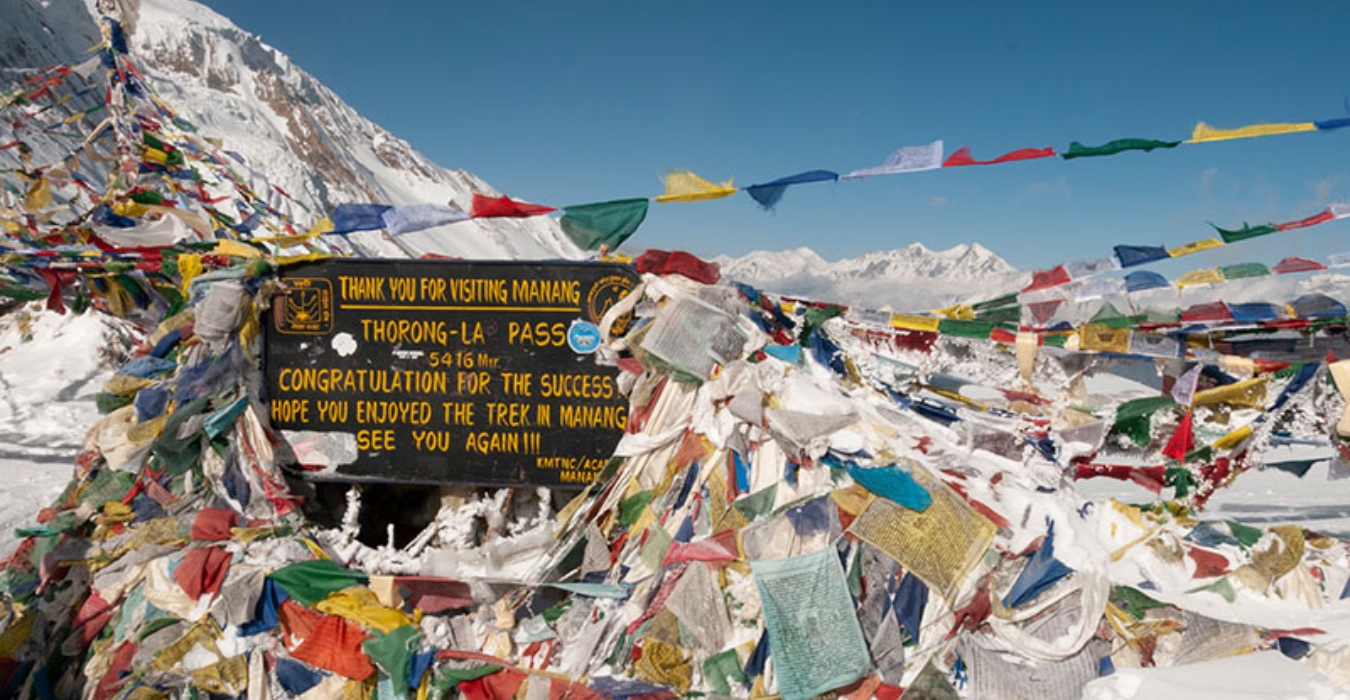
We begin early in the morning for the challenging ascent to Thorong La Pass (5,416 m), one of the highest trekking passes in the world. We climb gradually at our own pace, enjoying spectacular views of Khatung Kang (6,484 m) and Yakawa Kang (6,482 m). After reaching the summit, we celebrate our achievement and enjoy the breathtaking panorama before beginning the long descent towards Muktinath.
Muktinath is an important pilgrimage destination for both Hindus and Buddhists. We visit the sacred temple complex, famous for its eternal flame and natural water springs, before settling into our lodge for the night.
After breakfast, we leave Muktinath and climb towards a mountain pass at approximately 4,000 m, enjoying magnificent views of Dhaulagiri and the surrounding Himalayan landscape. We then descend towards Lupra, a unique traditional village known for its ancient Bon religion and distinctive cultural heritage. After exploring the village, we continue through the beautiful Mustang landscape towards Jomsom, situated in the Kali Gandaki Valley.
We will take a drive from Jomsom to Pokhara. We will make a stop at Pokhara before moving on to Kathmandu. We will be staying overnight here at Pokhara.
Half-day sightseeing in Pokhara and evening flight back to Kathmandu
Your memorable journey through the Manaslu and Annapurna regions comes to an end today. After breakfast, our representative will transfer you to Tribhuvan International Airport for your international departure flight. We hope you leave Nepal with wonderful memories of the Himalayan landscapes, mountain villages, and the incredible experience of crossing two legendary high-altitude passes.
 Note:
If you have a private group and prefer a personalized experience, we can organize a custom trip tailored to your requirements and group size, running it any day you choose.
Plan a Private TripThe Manaslu and Annapurna Circuit Trek – 22 Days combines two of Nepal's most spectacular Himalayan trekking routes. Experience remote villages, ancient monasteries, diverse cultures, and breathtaking mountain scenery while crossing two iconic high-altitude passes: Larkya La (5,150 m) and Thorong La (5,416 m). With experienced guides, comfortable tea-house accommodation, and planned acclimatization, Alpinist Club ensures a memorable Himalayan adventure.
Read MoreYour Manaslu and Annapurna Circuit Trek will be led by an experienced, English-speaking trekking guide familiar with the route, local culture, mountain conditions, and high-altitude trekking. Our trekking team works together to manage daily activities, organize accommodation, transport luggage, and provide assistance throughout the journey.
Your guide monitors the group's well-being and assesses weather, trail, and altitude conditions. The itinerary may be adjusted when necessary to prioritize everyone's safety. All safety-related decisions made by the guide must be respected.
The Manaslu and Annapurna Circuit Trek is a challenging high-altitude adventure designed for trekkers with good physical fitness, endurance, and previous multi-day trekking experience.
The journey involves approximately 5–8 hours of walking on most trekking days, with some longer and more demanding stages, particularly during the crossings of Larkya La and Thorong La passes.
The route reaches elevations above 5,000 metres, with Thorong La Pass at 5,416 m being the highest point of the journey. Steep ascents, long descents, rocky trails, changing weather, and high-altitude conditions add to the challenge.
Preparation recommendations:
You will generally carry only a daypack containing personal essentials, while porters transport your main trekking luggage according to the agreed baggage allowance. Previous high-altitude trekking experience is strongly recommended.
During your stay in Kathmandu, accommodation will generally be provided in a comfortable 3-star category hotel on a twin-sharing basis, including breakfast, according to your package arrangements.
Hotels may include Hotel Himalayan Suite or Sampada Garden, subject to availability and booking confirmation.
The Manaslu and Annapurna Circuit routes offer a network of local tea houses and mountain lodges. Accommodation is generally arranged in twin-sharing rooms, providing a comfortable place to rest after each day of trekking.
Accommodation facilities generally include:
In lower villages, accommodation facilities are generally more comfortable. However, facilities become increasingly basic at higher elevations, particularly around Dharamsala, Thorong Phedi, and High Camp.
Private bathrooms may not be available at every overnight stop. Trekkers should be prepared for simple accommodation and changing mountain conditions.
Nutritious meals are important for maintaining energy throughout the trek. Breakfast, lunch, and dinner are generally served at local tea houses and mountain lodges.
The menus offer a combination of traditional Nepali dishes and familiar international meals, depending on location and availability.
Typical Daily Menu
Dal bhat is one of the most popular meals during the trek because it provides a good source of energy for long walking days. Meal options depend on the location, food supplies, and availability at individual lodges.
Safe drinking water is essential throughout the trek. We recommend carrying reusable water bottles and suitable water purification equipment, such as purification tablets, drops, or a reliable water filter.
Your guide will advise you on safe drinking water arrangements and available refill points along the route. Bottled water may be available in villages at an additional cost.
To reduce plastic waste, we encourage all trekkers to carry reusable bottles and avoid unnecessary single-use plastic.
Transportation is an important part of the Manaslu and Annapurna Circuit Trek because the journey begins with a long overland drive and finishes with a domestic flight from the Mustang region.
According to the itinerary, transportation includes:
Flights between Jomsom and Pokhara are highly dependent on weather conditions, visibility, and operational schedules. Delays and cancellations can occur, sometimes requiring additional waiting days or alternative transportation.
If the Jomsom–Pokhara flight is cancelled, alternative road transportation may be required. This can involve a long and potentially uncomfortable journey.
We recommend keeping contingency days in your international travel schedule and avoiding international flight connections that leave insufficient time for unexpected delays.
Any additional costs arising from flight cancellations, alternative transportation, or extended accommodation will be handled according to the agreed package arrangements.
The Manaslu and Annapurna Circuit Trek is suitable for both private departures and small-group trekking arrangements. Small groups allow for better coordination, personalized attention from the guide, and a more enjoyable trekking experience.
Group size, guide arrangements, porter support, and final pricing will be confirmed before booking. Private departures can also be organized upon request.
Proper trekking equipment is essential for comfort, safety, and protection against changing weather conditions, especially when crossing Larkya La and Thorong La passes.
Trekkers should bring suitable clothing, warm layers, waterproof outerwear, trekking boots, and other personal essentials.
Recommended Personal Equipment
Your main trekking luggage will be carried by porters according to the agreed baggage allowance. We recommend keeping your luggage compact and avoiding unnecessary items.
You should carry a small daypack containing drinking water, snacks, rain protection, warm clothing, valuables, personal medication, and other essential items.
Items not required during the trek may be stored at your Kathmandu hotel, subject to hotel arrangements.
Mobile phone coverage is available in some villages along the Manaslu and Annapurna trekking routes, but reception becomes limited or unavailable in remote mountain sections.
For safety, your trekking guide will coordinate communication and emergency arrangements according to the location and available facilities.
Satellite communication equipment, such as a satellite phone or satellite messenger, may be used where necessary, depending on the operational arrangements.
Trekkers should keep their mobile phones charged and carry a power bank. Charging facilities are available at many tea houses, sometimes for an additional fee.
The Manaslu and Annapurna Circuit Trek reaches elevations above 5,000 metres, where the risk of altitude-related illness increases. Proper acclimatization, hydration, and careful monitoring are essential.
Our experienced guide monitors trekkers throughout the journey and adjusts the walking pace or itinerary when necessary.
Travel insurance must cover high-altitude trekking up to at least 5,500 metres, emergency medical treatment, hospitalization, and helicopter evacuation.
Emergency evacuations in remote mountain areas may take considerable time because of weather conditions, altitude, and accessibility.
Good general health and physical preparation are important for completing this challenging Himalayan adventure.
Before departure, we recommend consulting your healthcare provider about high-altitude trekking, physical preparation, vaccinations, existing medical conditions, and any medications you may need.
A dental check-up before travelling is also advisable, as access to dental services is limited in remote mountain villages.
Your travel insurance should cover:
Please carefully check your insurance policy to ensure that it covers the actual maximum altitude and activities included in your itinerary.
The best seasons for the Manaslu and Annapurna Circuit Trek are spring and autumn, when weather conditions are generally more favorable for trekking and mountain views.
Spring is one of the most beautiful seasons for trekking in Nepal. The weather is generally pleasant, rhododendron forests bloom, and mountain views are often spectacular. Higher elevations can still experience snow and cold conditions.
Autumn is considered one of the best trekking seasons, offering generally stable weather, clear mountain views, and comfortable daytime temperatures. It is an excellent period for crossing both Larkya La and Thorong La passes.
Winter brings very cold temperatures at higher elevations, with possible heavy snowfall and pass closures. Crossing both high-altitude passes may become difficult or unsafe.
The monsoon season brings heavy rainfall, cloudy mountain views, slippery trails, and possible landslides, particularly in the lower sections. This is generally a less favorable period for the trek.
The Manaslu and Annapurna regions require several permits and official documents. Alpinist Club arranges the necessary trekking permits according to the itinerary and applicable government regulations.
Required Trekking Permits
Trekkers must follow the applicable restricted-area regulations, including guide and group requirements. Permit conditions, regulations, and fees may change according to government rules.
At Alpinist Club, we believe that exploring the Himalayas comes with a responsibility to protect their natural and cultural heritage.
The Manaslu and Annapurna regions are home to diverse ethnic communities, ancient monasteries, sacred landscapes, and fragile mountain ecosystems.
We encourage all participants to:
Together, we can help preserve the extraordinary landscapes and cultural heritage of the Manaslu and Annapurna regions for future generations.
14. Booking Procedure and Payment
To confirm your Trek reservation, we require a 15% advance payment through bank transfer.
After confirming your booking, please provide:
The remaining balance can be paid upon arrival in Nepal through cash, bank transfer, Wise, Western Union, or credit card, subject to applicable transaction charges.
Our team will assist you with the payment process and pre-departure arrangements.
Alpinist Club can arrange short-notice trekking departures, subject to permit processing, guide availability, transportation, and accommodation arrangements.
For last-minute bookings, all required documents must be submitted promptly, and full payment is required at least 24 hours before departure, subject to the time needed for permit processing.
Please note that last-minute arrangements may be affected by weather conditions, road delays, and limited accommodation availability.
For assistance:
Why end your journey after exploring Manaslu and annapurn circuit trek? Nepal offers many opportunities to extend your holiday with additional adventures and cultural experiences.
Alpinist Club can arrange:
The Manaslu and Annapurna Circuit Trek is a remarkable journey combining two legendary Himalayan routes into one unforgettable adventure. From the traditional villages and Buddhist monasteries of the Manaslu region to the spectacular mountain landscapes of the Annapurna region, every stage offers a unique cultural and natural experience.
Crossing Larkya La and Thorong La passes is a major achievement and requires proper preparation, good physical fitness, and respect for high-altitude conditions.
With Alpinist Club's experienced trekking team, carefully organized logistics, and local knowledge, you can enjoy a rewarding Himalayan adventure.
Join Alpinist Club and discover the extraordinary beauty of the Manaslu and Annapurna regions in one incredible journey.
Less More


You need the following permits:
- Manaslu Restricted Area Permit (RAP).
- Manaslu Conservation Area Permit (MCAP).
- Annapurna Conservation Area Permit (ACAP).
